
Postpartum
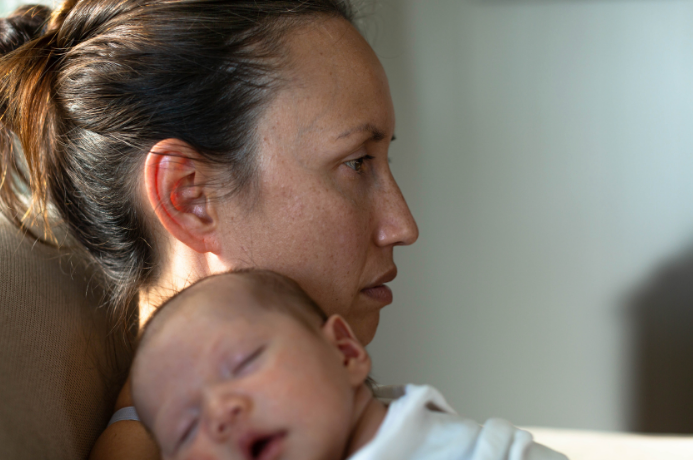
The Many Faces of Postpartum Emotions
20 MINUTE READ
Published July 2024
AUTHORS
Katie Sardone, PhD PMH-C
Head of Clinical, Licensed Psychologist & Perinatal Mental Health Specialist

Ann Dunnewold, PhD, PMH-C
Advisory Board, Licensed Psychologist

Bringing home a new baby can be one of the most wonderful times in your life, full of joy and special moments. But for many, the picture isn’t always so perfect. While this expectation of new baby bliss bombards new parents in social and media interaction, becoming a parent is a major life transition. Just like launching a career, choosing a life partner, or establishing a home, the reality is that joy and excitement is often accompanied by stress and mixed feelings.


What to expect when the unexpected occurs
Research shows that up to 85% of new parents (Henderson & Redshaw, 2013) have some negative feelings in the transition to parenthood. These feelings can range from tearfulness and exhaustion in the first weeks to powerful anxiety, depression, panic, and even frightening changes in your thinking. You’ve probably heard about the “baby blues” and postpartum depression, commonly referred to as “postpartum.” Since there is a wide range of feelings and reactions possible in the first year after becoming a parent, health professionals use the term “perinatal mood and anxiety disorders,” or PMADs. The term “perinatal” encompasses the entire child-bearing span, from pregnancy through the first year after birth. In this primer we’ll walk you through what is normal or “expected” following the birth of a baby as well as when you may need to seek help from a medical or mental health professional. If you are reading this and identifying with symptoms found below, it can feel scary and overwhelming, to say the least. The most important thing to know (before you get down to the nitty gritty below) is that PMADs actually have a great prognosis. When women identify symptoms early and seek help, they most often do get better! You are not alone in these challenges and there is help available for you including your Triplemoon Doula and team of specialists.
Breaking it down further
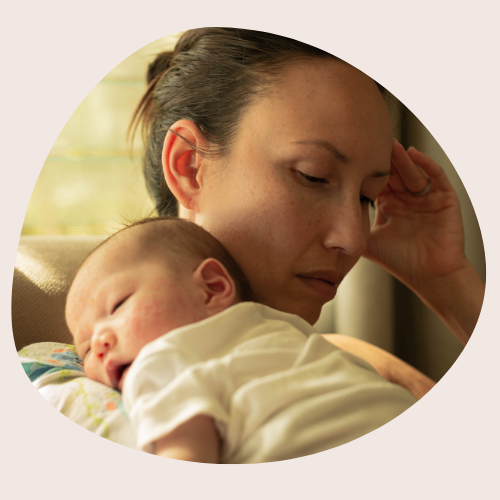
What contributes to physical and emotional changes after bringing home a newborn?
A slew of environmental, individual, relational and physical changes during pregnancy, birth, and lactation impact both the brain and the body, affecting birthing and non-birthing parents alike.
Sleep deprivation
A surge of bonding hormones
The nonstop schedule of caring for a brand-new human
Individual and relationship role changes
Increased responsibility
Lifestyle changes
Facing the often unrealistic expectations of what parenting a newborn is like

What’s Normal and What’s Not?
Becoming a parent is one of the most momentous events in life. No matter your experience, it’s a game changer. It is completely normal to feel worried, exhausted and doubtful about your ability to get through the next 24 hours, let alone foster this small human into a competent, functioning, secure adult over the next quarter century! While nearly every parent has normal moments of overwhelm and worry, research has delineated a range of reactions across the first parenting year. We can use the information below to monitor symptoms and mood and understand when to get help.
The most mild reactions are the baby blues and normal adjustment. Additional reactions which can range from mild to moderate to severe include postpartum depression, postpartum anxiety (including panic and obsessive thinking), post-traumatic stress, bipolar reactions, and postpartum psychosis. These reactions can overlap in the postpartum period, rather than being distinct categories, so that a new parent may identify with more than one. Often, symptoms can be traced to pregnancy or even before, with a worsening in the postpartum period. In fact 50% of cases of PMADs began during pregnancy so it’s important to seek treatment whenever these symptoms emerge! (Verreault et al, 2014.)
Tipping the scale from “normal” to potential PMAD
At any point, the balance may tip, with bad days outweighing the good days. This transition into depression or anxiety is a matter of severity, timing, and duration. As bad days drag on, parents may doubt even further their ability to conquer this new role. Self-esteem can take a hit, as parents worry “what’s the matter with me?” or “Am I a failure as a parent?”
-
The baby blues are so common as to be considered normal, affecting up to 60-80% of new parents (Rezaie-Keikhaie, 2020). The blues are likely related to the extreme hormone fluctuations, dropping from the highest levels (in late pregnancy) to even lower levels than menopause in the few days after birth. The blues typically last a few days to a couple of weeks, as acute sleep deprivation and fatigue fuel the continued hormonal imbalance. Another hallmark of the blues is they usually resolve on their own, without any intervention or concern.
-
Normal adjustment, from 2 weeks through the first couple of months postpartum, can continue to be an emotional rollercoaster of mood, fatigue, reactivity, and feeling overwhelmed. New learning and challenges abound, and this stress can leave parents feeling imbalanced and uncertain. As long as good days of positive mood and small moments of mastery outweigh the bad days filled with worry and overwhelm, this reaction is still of minimal concern. Like the blues, these feelings usually resolve on their own, once the baby begins to sleep longer and becomes more predictable. Adjusting to this “new normal” allows parents to feel less exhausted and more successful at this new endeavor.
-
Postpartum depression can look very much like an exacerbation of earlier sadness and irritability. One in five women (Smythe et al., 2022) and one in seven men (Rao et al. 2019) experience postpartum depression . Similarly, postpartum anxiety may feel like an extension of the worry of the first postpartum weeks, as parents struggle to master this new role. Approximately one in six new mothers (Smythe et al., 2022) and one in ten new fathers (Leiferman et al., 2021) experience some form of postpartum anxiety. This anxiety can stand alone, or show several variations, including obsessive worry or panic attacks. While research has shown that “scary thoughts” (i.e., thoughts of harm that can come to the baby) are normal, appearing in up to 80% of new parents, only 1 in 10 women get stuck obsessively on these thoughts, playing again and again in their minds (Abramowitz et al., 2003). Postpartum panic disorder can involve full blown panic attacks, with racing heart, shortness of breath, chest pain, and dizziness and occurs in about 7% of new parents (Beck, 2021). Postpartum post-traumatic stress occurs in about 1 in 10 postpartum women (Hernandez-Martinez, et al., 2019). Reactions can be linked to either a recent trauma, such as an aspect of the birth, or a past trauma, such as a previous sexual assault or vehicle accident.
-
Although it isn’t as common, Bipolar disorder can arise for the first time after a birth as the biochemical changes of pregnancy and the postpartum period trigger a sensitivity in the new parent. Most commonly, there is a family history of bipolar disorder creating this genetic predisposition. If a woman has a previous diagnosis of bipolar disorder, the possibility of relapse is 55% to 71% after a birth (Masters et al., 2022). Postpartum bipolar disorder, new onset, appears only in about 3% of new parents (Masters et al., 2022).
-
Postpartum psychosis is the most rare and most serious of the PMADs, occurring only 1-2 times in a thousand new parents (Bergink, 2011). Onset of postpartum psychosis is usually within the first two weeks after birth, though it is possible at later times with weaning from breastfeeding. Symptoms of psychosis include insomnia, serious confusion, mood swings, hallucinations and delusions (e.g., seeing, hearing, believing what others do not.) Postpartum psychosis is often described as mercurial, changing rapidly from exhibiting symptoms to appearing normal. The risk of suicide (5%) and infanticide (4.5%) warrants immediate medical attention for the parent experiencing these symptoms (Spinelli & Bramante, 2022).

What the research says
PMADs are the single most common postpartum complication, more prevalent than infections or other physical impacts.
According to the CDC, 53% of pregnancy related deaths occur postpartum and of those deaths, mental health complications are the leading cause (followed by excessive bleeding, cardiac complications, and several others.)
When parents (and their support systems) know the symptoms to look for, identifying appropriate help in a timely manner happens, ensuring quicker recovery and less impact on parent, baby, and other relationships.
Being informed about health issues is an important part of self-care, and when you take care of yourself, you are more available as a parent.
What it might look like for you

-
When to watch: First 2 days to 2 weeks, peaking 3-5 days after the birth
What you might feel:
Tearfulness
Mood up and down
Feeling reactive
Good days outnumber the bad days
Exhaustion
What increases your risk:
The rapid fall of hormones from the high of pregnancy to the low of the first 72 hours after birth
The physical toll on the body of the birth process
-
When to watch: First three months
What you might feel:
Exhaustion
Irritability
Feeling reactive
Mixed emotions
Good days outnumber the bad days
Growing confidence
Doubts about your ability to parent
What increases your risk:
Sleep deprivation
EVERYTHING is a new challenge
Uncertainty about how to be a parent
Lack of training for the role
Lack of practical or emotional support
Unrealistic expectations
-
When to watch: Anytime in the first year after birth
What you might feel:
Exhaustion
Sadness, crying
Unexplained physical complaints (stomach or head aches)
Appetite changes
Sleep disturbances
Poor concentration/focus
Irritability, anger
Hopeless, helpless
Guilt, shame
Overwhelmed
Feeling disconnected from baby
Inability to take care of self or family
Loss of interest, joy, pleasure
Anxiety
Isolation
Mixed emotions
Worthlessness, self-doubt
Intense, intrusive scary or worried thoughts often related to harm to baby or self
What increases your risk:
Sleep deprivation
Family history of depression
Previous personal experience of depression
Previous history of difficulty with hormonal transitions, such as PMS/PMDD or fertility issues
Relationship conflict
-
When to watch: Anytime in the first year following birth
What you might feel:
Agitated, irritable, restless
Inability to sit still
Excessive concern about baby’s or own health
High alert
Appetite changes, often rapid weight loss
Sleep disturbances (difficulty falling or staying asleep)
Constant worry
Racing thoughts
Intense, intrusive scary or worried thoughts often related to harm to baby or self
What increases your risk:
Sleep deprivation
Family history of anxiety
Previous personal experience of anxiety
Previous history of difficulty with hormonal transitions, such as PMS or fertility issues
Relationship conflict
-
When to watch: Anytime in the first year following birth
What you might feel:
Any of the symptoms of postpartum anxiety PLUS
Intrusive, repetitive thoughts about harm that can come to baby or others
Getting stuck on these thoughts
Hypervigilance
“What if” thinking
Avoidance of situations that could trigger harming thoughts, such as bathtime
Horrified by the thoughts–”this is not who I am!”
Guilt, shame
Cleaning, checking, ordering, obsession with germs
What increases your risk:
Any of the factors above PLUS
Previous obsessive thinking or behavior
-
When to watch: Anytime in the first year following birth
What you might feel:
Any of the symptoms of postpartum anxiety PLUS
Episodes of extreme anxiety
Shortness of breath, chest pain, sensations of
choking/smothering
Dizziness
Hot or cold flashes, trembling, numbness or tingling
Racing heart or palpitations
Fear of dying, going crazy, or losing control
What increases your risk:
Any of the factors above PLUS
Previous panic attacks
-
When to watch: Anytime in the first year following birth
What you might feel:
Any of the symptoms of depression and anxiety listed above, PLUS
Flashbacks, nightmares, distressing memories
Negative, stuck thoughts
Persistent, distorted blame of self or others
What increases your risk:
Any identifiable trauma
Past trauma such as childhood sexual abuse, sexual assault, sudden death of a loved one, natural disaster, auto accident.
Recent trauma surrounding the birth, such as postpartum hemorrhage, emergency Cesarean delivery, NICU admission, preeclampsia
-
When to watch: Anytime in the first year following birth, likelihood increases with sleep deprivation
What you might feel:
Any of the symptoms of anxiety and depression, above, PLUS
Irritability, agitation
Decreased need for sleep, hyperactivity
Racing thoughts, often with unrealistic or exaggerated ideas
Increased energy
Pressured speech
Others likely to see behavior as more out of character than does the person experiencing the symptoms
What increases your risk:
Personal history of bipolar disorder
Family history of bipolar disorder
Severe sleep deprivation
-
When to watch: Anytime in the first year following birth, most common in the first two weeks
What you might feel:
Any of the symptoms of depression and anxiety, PLUS
Poor concentration
Disoriented, confused
Agitated, hyperactive
Rapidly changing mood
Rambling speech, ideas flow oddly
Thoughts of paranoia or grandiosity
Seeing, hearing, or thinking things which others do not
What increases your risk:
First baby
Previous bipolar or psychotic episodes
Family history of bipolar or psychotic episodes
Severe sleep deprivation
Perinatal and neonatal loss
About the authors
Katie Sardone, PhD, PMH-C
Dr. Katie Sardone is a Licensed Psychologist and the founder of Behavioral Health Dallas, PLLC.

Ann Dunnewold, PhD
Ann has dedicated her career to guiding clients through the transition to parenthood. In addition to her role as a licensed psychologist, Ann has held numerous industry leadership positions…

Nutritionists
•
Adult mental health
•
Couples mental health
•
Infant & child mental health
•
Sleep coaching
•
Nutritionists • Adult mental health • Couples mental health • Infant & child mental health • Sleep coaching •

When to get
expert support
Sometimes you might need more support, and that's okay! Here are times you may consider reaching out to a specialist:
When you feel the bad days outweigh the good days.
If you have difficulty with the basics of daily life: sleeping, nourishing yourself, taking care of personal hygiene, parenting, or other responsibilities.
If you have thoughts of harming yourself, the baby, or anyone else.
If you feel that the baby dislikes you.
If you just need to talk about it, and feel you are wearing out your support system with your concerns.
-
Abramowitz, J. S., Meltzer-Brody, S., Leserman, J., Killenberg, S., Rinaldi, K., Mahaffey, B. L., & Pedersen, C. (2010). Obsessional thoughts and compulsive behaviors in a sample of women with postpartum mood symptoms. Archives of women's mental health, 13, 523-530.
Ali, E. (2018) Women’s experiences with postpartum anxiety disorders: a narrative literature review. International Journal of Women’s Health. 10: 237–249.
Baldwin, S., Malone, M., Sandall, J. & Bick, D.. (2018) Mental health and wellbeing during the transition to fatherhood: a systematic review of first time fathers' experiences. JBI Database of Systematic Reviews and Implementation Reports, 16(11):2118-2191.
Beck, C. T. (2021). Postpartum onset of panic disorder: A metaphor analysis. Archives of Psychiatric Nursing, 35(4), 369-374.
Bergink, V., Lambregtse-van den Berg, M. P., Koorengevel, K. M., Kupka, R., & Kushner, S. A. (2011). First-onset psychosis occurring in the postpartum period: a prospective cohort study. The Journal of clinical psychiatry, 72(11), 13340.
Henderson, J., & Redshaw, M. (2013). Who is well after childbirth? Factors related to positive outcome. Birth, 40(1), 1-9.
Hernández-Martínez, A., Rodríguez-Almagro, J., Molina-Alarcón, M., Infante-Torres, N., Manzanares, M. D., & Martínez-Galiano, J. M. (2019). Postpartum post-traumatic stress disorder: Associated perinatal factors and quality of life. Journal of affective disorders, 249, 143-150.
Holopainen A, Hakulinen T. (2019) New parents' experiences of postpartum depression: a systematic review of qualitative evidence. JBI Database of Systematic Reviews and Implementation Reports, 17(9):1731-1769.
Leiferman, J.A., Farewell, C.V., Jewell, J., Lacy, R., Walls, J., Harnke, B., Paulson, J.F. (2021) Anxiety among fathers during the prenatal and postpartum period: a meta-analysis. Journal of Psychosomatic Obstetrics and Gynaecology, 42(2): 152-161.
Liu, X., Wang, S., & Wang, G. (2021) Prevalence and Risk Factors of Postpartum Depression in Women: A Systematic Review and Meta-analysis. Journal of Clinical Nursing, 31(19-20), 2665-2677.
Masters, G.A., Hugunin, J., Xu, L., Ulbricht, C.M., Moore Simas, T.A.,Ko, J.Y., & Byatt, N. (2022) Prevalence of Bipolar Disorder in Perinatal Women: A Systematic Review and Meta-Analysis. Journal of Clinical Psychiatry. 13; 83(5)
Rao, W.W., Zhu, X.M., Zong, Q.Q., Zhang, Q., Hall, B.J., Ungvari, G.S., Xiang, Y.T. (2019) Prevalence of prenatal and postpartum depression in fathers: A comprehensive meta-analysis of observational surveys. Journal of Affective Disorders, 263:491-499.
Rezaie-Keikhaie, K., Arbabshastan, M. E., Rafiemanesh, H., Amirshahi, M., Ostadkelayeh, S. M., & Arbabisarjou, A. (2020). Systematic review and meta-analysis of the prevalence of the maternity blues in the postpartum period. Journal of Obstetric, Gynecologic & Neonatal Nursing, 49(2), 127-136.
Smythe, K.L., Petersen, I., & Schartau, P., (2022) Prevalence of Perinatal Depression and Anxiety in Both Parents: A Systematic Review and Meta-analysis. JAMA Network Open.5(6):e2218969.
Spinelli, M., & Bramante, A. (2022). Maternal suicide and filicide. In Key Topics in Perinatal Mental Health (pp. 185-198). Cham: Springer International Publishing.
Verreault, N., Da Costa, D., Marchand, A., Ireland, K., Dritsa, M., & Khalifé, S. (2014). Rates and risk factors associated with depressive symptoms during pregnancy and with postpartum onset. Journal of Psychosomatic Obstetrics & Gynecology, 35(3), 84-91.