
Mental and Emotional Health

Swimming in Your Subconscious
15 MINUTE READ
Published July 2024
AUTHORS
Katie Sardone, PhD PMH-C
Head of Clinical, Licensed Psychologist & Perinatal Mental Health Specialist

Margaret Vadiee, PhD
Contributing Editor, Licensed Psychologist

Our experiences shape us and how we interact with others - even our children. It can be tempting to ignore all those things you don’t want to talk about. But the less we avoid our past selves or what has happened to us, the less the past has power over us. Let’s understand how swimming in our subconscious helps us be the parents we want to be.


Wading through the waters of our past
Imagine you're tasked with cleaning the mud out of a glass of water, with the goal of having a glass of crystal clear water by the end. The bulk of the mud has settled at the bottom, but the water still has a light brown hue. To make the water clear again, you have to scoop the mud out. Scooping the mud out turns the water from light brown to dark brown. It looks worse before it’s better. Processing one’s past is like cleaning the glass of muddy water. It requires the hard work of acknowledging and reflecting on previous life experiences before gaining more clarity and power in the present.
Breaking it down further
A person’s past impacts them. That’s true for everyone! Nothing is wrong with someone for having their past impact them. No one’s present or future is doom and gloom because of what may have happened to them. When you take the time to understand how your childhood and/or past experiences affect you, you can start to make different decisions than the ones fueled by your subconscious.
One way our past influences our present is through implicit memories. An implicit memory is something that you know, but is hard to put into words. Examples include breathing, walking, or riding a bike. Even though it’s hard to verbalize them, our implicit memories greatly impact how we move throughout our day - both physically and emotionally. When a child cries out to a parent, the parent remembers (implicitly) what it was like to cry out for their parent when they were a child. Of course the parent is not consciously reflecting on their childhood at that moment, but the network of memories stored in their brain still surfaces.
Implicit memories from our past, including experiences with our parents from when we were children, impact how parents respond to their children, subconsciously. How you were parented influences how you parent. What was modeled to you matters, and often becomes our default mode unless we have reflected with intention and have the awareness to emulate what was helpful and make changes as needed. Therapy can be very helpful with the process of reflection and making things conscious that were previously subconscious. Without reflection and insight, parents may be on auto-pilot and make decisions without considering what their child needs at that moment. Further, without reflection parents may have trouble being attuned to their child and misinterpret the meaning of their child’s behavior.
Sometimes these implicit memories from our past impact parents in subtle ways. Sometimes they impact parents more significantly - this tends to happen if the implicit memory touches on an instance stored with a strong emotion, like fear. An implicit memory may make it challenging for a parent to be aware of what is going on around them. They may think they are present, but are actually only taking in some of the information. Implicit memories have the potential to distract and disconnect us from the present moment and cause us to act on old information as opposed to what's happening right now in the present.

For example, imagine that you are at the preschool’s spring carnival with your child, an event that caused you and/or your parent great anxiety as a child. You look around and see your child apart from other children for a moment and make a quick assumption that your child would like to be swooped up and rescued from this situation. You decide to hold them for the rest of the carnival. However, what you weren’t paying attention to was your child’s experience in the moment - their facial expression, body language and emotion. Your child was actually content, excited to play with other children but taking a moment to look at all of the options and decide where to jump in. Being caught up in your own past emotions and experiences makes it hard to really see what’s going on in the present and make helpful choices for the now.
Or maybe instead, you have been looking forward to the preschool’s spring carnival. You’ve been meaning to catch up with the other parents and can’t wait to see your child trying out all of the activities. When you get there, your child has both arms wrapped around your leg in a tight grip. They’re not letting go. All you want is for your child to go enjoy it. You’re tempted to pry their arms off your leg and encourage them to join their friends. But, you decide to check in with your child and consider their perspective. You realize they need some time next to you before feeling comfortable at the carnival. After all, this is a new experience for them! Your awareness of your own desires (i.e., to talk with the other parents) and your child’s desires (i.e., to stay close to you until they have a better grasp on the new event) helps you make decisions in line with what your child needs, rather than reacting based on your own needs.
The trick to managing our subconscious, and everyone has one, is to begin to recognize when you’re getting swept away in the current of the past and re-ground yourself in the present. For example, take the spring carnival example above. If you begin to notice strong feelings at the carnival, pause and ask yourself, “is this about me or my child?” Intentionally set your feelings apart from your child’s experience and notice your child independently. Make decisions based on your child’s needs in the present moment; leave the past in the past!

What the research says
Children have implicit memories about the way the world works by the time they are one year old (Siegel, 2001).
How a mother thinks about their infant predicts later attachment security in the parent-child relationship, which is associated with many benefits (Meins et al, 2001).
Putting it into practice
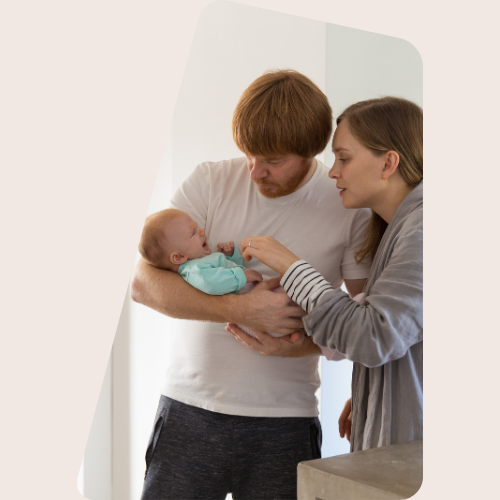
YOUR BABY IS STILL CRYING.
-
Visceral reaction
You feel irritated. All he does is take, take, take, and you are exhausted. Why doesn’t he think about you? Doesn’t he remember how you were up 3 times last night? You’re hungry too.
Factors driving your implicit memories
You have implicit memories stored about feeling unworthy or not cared for that are resurfacing here. Your deep yearning to be taken care of presents as misdirected frustration and annoyance.
-
Acknowledge
You acknowledge that your baby has no way of identifying your needs, and is certainly not responsible for taking care of you.
Ground yourself in the present
Instead, you focus on running through the list in your head of why your baby may be crying - he’s fed, he’s clean, he’s rested. You then think about what it feels like to not really need anything in particular, but just feel “off.”
Meet your child’s needs in the now
You hold him closely and remind yourself that being with him makes a difference.
YOU’RE AT THE BIRTHDAY PARTY OF SOPHIE’S (YOUR TODDLER) CLASSMATE.
Sophie knows all the other children, but you don’t really know the other parents all that well. She’s standing next to you, and taps on your leg.
-
Visceral reaction
When you feel the tap on your leg, you are flooded with relief. This is your out - you no longer have to determine which parent you are going to try and befriend first. You don’t even look down to see what Sophie needed, and just pick her up, and spend the rest of the birthday party playing with her.
Factors driving your implicit memories
Without you even being aware, you are distracted by memories from your childhood. You never quite knew who to play with because you did not feel like you were part of the “group” growing up. You are rescued from an anxiety-provoking situation for you, but it’s not necessarily what Sophie would have benefitted from.
-
Acknowledge
You notice your deep desire to be rescued from making small talk with parents you don’t know.
Ground yourself in the present
You remind yourself that the purpose of the birthday party is for Sophie to have time with her friends. You pay attention to her verbal and nonverbal cues. She’s looking at the dollhouse with wide eyes and appears excited at the prospect of getting to play with it.
Meet your child’s needs in the now
You smile with her, delighting her in her excitement, and narrate her eagerness to play with her dollhouse with her friends. She gives you a one more big smile and a little shriek before running off to play with her friends.
YOU’RE AT THE NEIGHBORHOOD PLAYGROUND WITH JOSEPH, YOUR 4-YEAR-OLD.
He’s swinging on the monkey bars, which has been his go-to activity all week. He slips and has a short fall, like he has countless times, but calls out to you this time. He doesn’t look like he got hurt.
-
Visceral Reaction
Why is he calling out to you? You can see him from where you are seated on the bench. The fall looked minor and this happens all the time. You roll your eyes as you shout to him to get up and try again.
Factors Driving Implicit Memories
You have implicit memories stored of your parents telling you to “dust it off and keep going.” This happened a lot, but it was particularly impactful after falling during a t-ball game. You skinned your knee and felt a combination of embarrassment and disappointment. You wished your parents would just walk over and give you a pat on your back like your teammate’s parent did when they fell. Over time, you learned to always push through and avoid tough emotions because they “just got in the way of success.”
-
Acknowledge
You remember what was modeled to you when you were growing up: the “dust it off” attitude and the accolades for being someone who can handle anything on their own.
Ground yourself in the Present
You bring yourself back to the present and take a few steps to get a better view of what happened. He looks frightened. You do a quick scan of the monkey bars, and playground as a whole and don’t notice anything unusual.
Meet your Child’s Needs in the Now
When you walk over to him, Joseph says “bee, bee” quietly. You both remember when he got stung last month. He explains a bee landed on his arm while he was swinging on the monkey bars, which made him drop down. You listen to how he’s feeling and reassure him that he’s okay and it’s safe to continue playing if he wants to.
About the authors
Margaret Vadiee, PhD
Dr. Margaret Vadiee is a Licensed Psychologist and a former Adjunct Clinical Assistant Professor at Southern Methodist University in the Psychology Department.
Katie Sardone, PhD, PMH-C
Dr. Katie Sardone is a Licensed Psychologist and the founder of Behavioral Health Dallas, PLLC.


Nutritionists
•
Adult mental health
•
Couples mental health
•
Infant & child mental health
•
Sleep coaching
•
Nutritionists • Adult mental health • Couples mental health • Infant & child mental health • Sleep coaching •

When to get
expert support
Sometimes you might need more support, and that's okay! Here are times you may consider reaching out to a specialist:
You find yourself reacting to your child in ways that you wish you hadn’t.
You feel uncomfortable in situations when your child actually seems fine.
You want to better understand how your childhood or past experiences impact you.
-
Hoffman, K., Cooper, G., & Powell, B. (2017). Raising a secure child: How circle of security parenting can help you nurture your child's attachment, emotional resilience, and freedom to explore. Guilford Publications.
Meins, E., Fernyhough, C., Fradley, E., & Tuckey, M. (2001). Rethinking maternal sensitivity: Mothers' comments on infants' mental processes predict security of attachment at 12 months. The Journal of Child Psychology and Psychiatry and Allied Disciplines, 42(5), 637-648.
Siegel, D. J., & Hartzell, M. (2013). Parenting from the inside out: How a deeper self-understanding can help you raise children who thrive. Penguin.
Siegel, D. J. (2001). Memory: An overview, with emphasis on developmental, interpersonal, and neurobiological aspects. Journal of the American Academy of Child & Adolescent Psychiatry, 40(9), 997-1011.