
Nutrition Basics
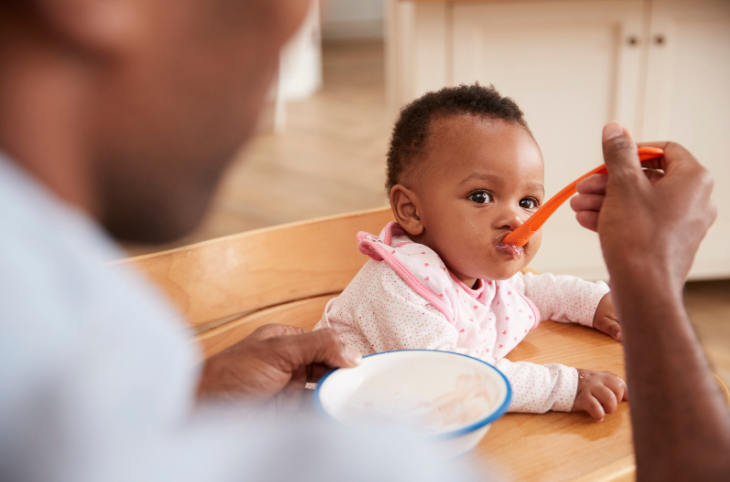
The First 1000 Days
Optimal Nutrition for Your Child
20 MINUTE READ
Published August 2024
AUTHOR
Megan Lyons
Owner of Lyons’ Share Wellness, Double Board Certified as a Clinical Nutritionist and Holistic Nutritionist & Doctorate of Clinical Nutrition (Cand)

Navigating the first 1000 days of your child's life is a lot and the conflicting nutrition advice that you hear from well-meaning friends, social media, and news sources can sometimes make us want to throw our hands in the air. This guide is designed to help you simplify things, offering you research-backed insights and practical steps to support your child’s health, development, and growth with the food that goes on their plates.


Nourishing your child for a healthy future
The first 1000 days of a child's life, from conception to age two, are critical for long-term health and development. What your child eats during this period can have profound effects on their cognitive function, physical growth, and overall well-being¹. In this guide, we’ll cover the essential nutrients needed during this time, the role of breastfeeding and complementary foods, and how to create balanced meals that support your child's growth. Our goal is to provide you with practical, research-backed information to help you feel confident and capable in nurturing your child's development.
Breaking it down further
The role of milk
From birth to 4 months babies should consume breastmilk or formula exclusively. How you choose the type of milk you offer your baby is a highly personal choice, and it may change / evolve as you and your child grow together! Ultimately, fed IS best. To find out more about breastfeeding and bottle feeding we recommend our “0-3 month intensive: eat, sleep, poop...repeat” Learning Program.
For avoidance of doubt, the American Association of PediatricLearning Programs (and Triplemoon!) recommend that babies continue to get their primary source of nutrients from formula or breastmilk through the first year of life (and beyond if able)⁹! However, the 6 month - 1 year timeframe marks an important developmental time frame during which your baby experiences new flavors, textures and develops the use of their fingers, hands, lips and tongue to eat! This guide will discuss the foods your baby should try in addition to breast milk or formula for the first 1000 days.

Introducing complementary foods
Around 4-6 months, infants often begin introducing complementary foods to instill behavioral patterns and supply additional nutrition. Here, we’ll give an overview of what nutrients and foods to focus on when you do choose to introduce complementary foods. In the first few weeks of transition, we are aiming to gradually introduce a variety of fruits, vegetables, whole grains, healthy fats, and proteins to ensure a balanced diet.
It’s also important to remember that a baby’s taste for sugar and sweet foods is formed based on exposure. Those exposed to less added sugar and overly processed foods often have more diverse palates that are accustomed to nutrient-dense foods like vegetables and fruits later in life, and have lower incidence of obesity later in life¹. Those children who are exposed to fewer flavors, and who are allowed to choose overly processed and sweetened foods whenever they please, often turn into picky eaters later in life. If you notice your child tending towards these options, it’s a great opportunity to pause and think about your own relationship with food and how you’re introducing various foods to your baby. Are your facial patterns indicating that broccoli may be “yucky” or cupcakes may be “yummy”? Aim for neutrality, so your baby can develop their own tastes. And remember that humans often need repeated exposure (up to 10 tries!) to appropriately conclude whether or not they “like” a food, so keep trying and have patience with yourself and your baby. There’s no such thing as perfection (remember, fed is best!), but minimizing added sugars and overly processed foods right now can pay off significantly for your child’s future health (and your sanity!).
FVFV: Fruits, Vegetables, Fats, and Vitamins
To make it easier for parents, we've developed the FVFV framework—focusing on Fruits, Vegetables, Fats, and Vitamins. These are the critical components of your child's diet that will support their health, development, and growth.
-
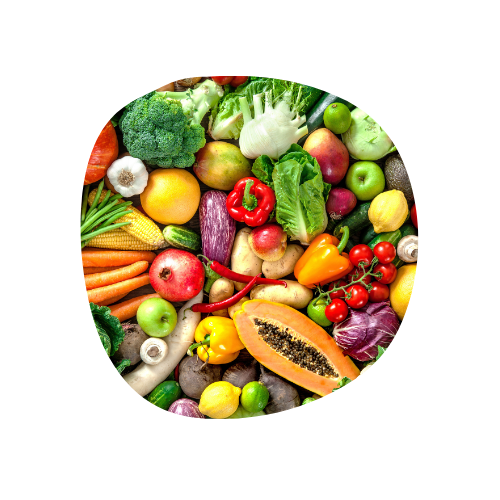
Fruits and Vegetables: These are packed with essential vitamins, minerals, and antioxidants that support your child’s immune system, brain development, and overall health. Introducing a variety of fruits and vegetables early on helps in developing a diverse palate and reduces the risk of picky eating later in life7.
-
F: Healthy Fats: Healthy fats are essential for brain development and overall growth. Foods like avocados, nuts, seeds, and fatty fish provide DHA, an omega-3 fatty acid crucial for cognitive and visual development4.
-
V: Vitamins and Minerals: Key vitamins and minerals, such as iron, calcium, and vitamin D, are necessary for your child's development. Iron supports cognitive and neurological development, calcium is crucial for bone growth, and vitamin D aids in calcium absorption and bone health6. We’ll talk about the importance of some of these vitamins and minerals in the Research section below.
And then there’s protein . . .
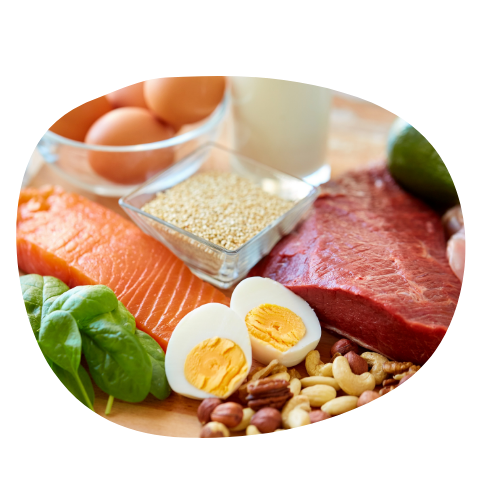
As adults, we hear a lot about the importance of protein, and it’s important for babies, too! Adequate protein intake is linked to more appropriate growth and development patterns. However, a baby’s need for protein is far less than an adults, and most babies will get enough protein without too much overthinking. So, while this isn’t part of our FVFV framework, know that it is a healthy option for your baby as well!

What the research says
Providing the right nutrients during the first 1000 days is crucial for your child’s development. Here are key nutrients and their roles:
FV: Fruits and Vegetables
Low vegetable and fruit intake in infancy is linked to higher obesity in later years¹. Research on various vitamins and minerals show important benefits for many areas that are developed in the first 1000 days, such as vision, brain health, energy, metabolism, growth, bone health, disease prevention, immune health, and more! And consistent research shows that early exposure to tastes like vegetables improves acceptance of these foods later in life⁷. Focus on having your child try a variety of fruits and vegetables, without attaching positive or negative emotion to them, and be patient if your child doesn’t prefer a food on the first time.
F: Healthy fats, including DHA
The Journal of Pediatrics has published research on the role of essential fatty acids, particularly DHA, in brain and visual development, which peaks during the first 1000 days. These studies indicate that infants with higher levels of these fats have improved cognitive and visual outcomes⁴. Present in breast milk, formula, and later, fatty fish, nuts and seeds (when safe), nut butters, olives, olive oil.
V: Vitamins and minerals
Iron: Introducing iron-rich foods early in your child’s first 1000 days is helpful because iron deficiency in early development has lasting implications for neurological and cognitive development¹. Iron deficiency anemia in early childhood is associated with long-term cognitive and behavioral issues. A study in Pediatrics showed the critical role of iron in neurodevelopment and the consequences of iron deficiency in infancy⁵.
Calcium and Vitamin D: Calcium is crucial for the development of strong bones and teeth in young children. According to a study published in Advances in Nutrition (2023), adequate calcium intake during the first 1000 days is vital for proper skeletal development and overall growth. This period is critical for establishing bone density, which has long-term implications for bone health and the prevention of osteoporosis later in life⁶.
And a note on protein . . .
A study published in the American Journal of Clinical Nutrition highlights the importance of adequate protein intake for growth and development in early childhood. It emphasizes that protein malnutrition can lead to growth retardation and impaired cognitive development³. The recommended intake of protein for children 4-12 months is 0.6 grams of protein per pound of body weight per day², which is about 10-15 grams of protein per day. This is not a ton; for reference, one egg has 6 grams, ½ cup of yogurt has 9 grams, and one ounce of chicken breast has 7 grams. There’s even some research suggesting that a very high protein intake as an infant can contribute to obesity later in life², so stick to just a few bites of protein at most meals and you’ll strike the right balance. High-quality sources include breast milk, formula, and later, lean meats, eggs, and legumes.
Putting it into practice
If you’re reading this guide, we know you’re probably paying close attention to what your baby eats. Below are some great guidelines to help you balance their meals. The key is not necessarily to get ALL of the items at EVERY meal, but rather to work these items in over the day or week in the quantities recommended below. Your Triplemoon coach can help come up with a mechanism for your family to help track this, if useful, and/or more ideas that fit your families tastes and preferences!
Your child’s nutrition checklist

Breastfeeding and formula feeding
Continue breastfeeding or formula feeding for the first 4-6 months, then combine with complementary foods. A conversation with your doctor around timing is key to make sure the pros of introducing solids early outweigh the cons. You want to make sure your baby has the right physical strength, head and neck control to manage solids. Bring this up during your 4 month checkup and again at your 6 month checkup (and with your Triplemoon coach)!
Once you plan to introduce complementary foods, focus on FVFV.
For the first 1000 days, use this framework to get in 3-4 vegetables and fruits per day, 2 or more healthy fats per day, and 3-4 servings of iron and calcium rich foods per week! This supports the critical processes that are developing in your child’s first 1000 days.
FV: Include a variety of fruits and vegetables.
Aim to introduce different fruits and vegetables regularly to develop a diverse palate and ensure a wide range of nutrients. Can you reach towards 3-4 different vegetables and fruits per day for your baby.
F: Incorporate healthy fats.
Add foods like avocados, nuts (when appropriate), seeds, egg yolks, olive oil, and fatty fish to support brain development. Aim to get in 2 of these items per day for your baby!
V: Focus on plenty of vitamins and minerals, especially the ones below.
Aim to get in 3-4 foods from the lists below each week.
Introduce Iron-Rich Foods: Start with pureed meats and vegetables and fruits from the list here to prevent iron deficiency. Sources of iron include meats, seafood, legumes, spinach, kale, collard greens, beet greens, chard, sweet potatoes, broccoli, string beans, strawberries, watermelon, figs, dates, raisins, dried apricots, prunes, and oats.
Ensure Sufficient Calcium and Vitamin D: Include dairy or fortified plant-based milks, leafy greens, and other calcium-rich foods at least once per day. Calcium is found in breast milk, formula, dairy products, fortified plant-based milks, beans, leafy greens, sardines, nuts and seeds (when safe), and figs. Vitamin D comes mainly from sun (no need to risk your baby burning, but even a few minutes per day of sunlight can help their production!), but is also fortified in many of the foods in the calcium list.
Protein
Adding in some protein is helpful! Aim for a few bites per meal of a protein-containing food, like eggs, meat, chicken, fish, yogurt, beans, or lentils.
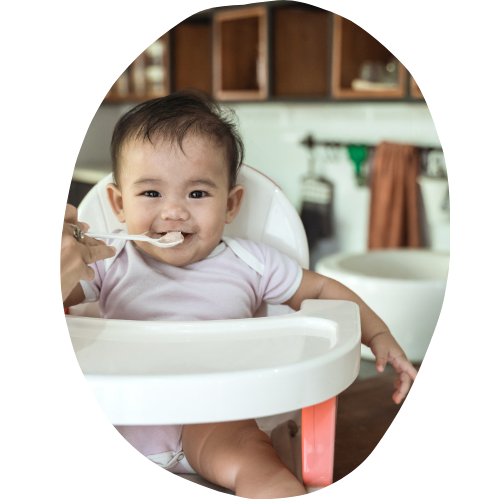
What it might look like in your home
-
Bananas (F: fruit), berries (F: fruit), spinach (V: vegetable), yogurt (protein) and avocado (F: healthy fat).
Spinach and calcium are also rich in calcium (V: vitamins and minerals) and spinach is rich in iron (V: vitamins and minerals).
-
Asparagus (V: vegetable), scrambled eggs (F: healthy fat and protein).
Asparagus and eggs are both rich in many nutrients like vitamins A, D, K, and choline (V: vitamins and minerals)
-
Salmon (F: healthy fat and protein), mashed sweet potato (V: vegetable), and olive oil (F: healthy fat).
Salmon has Vitamin D (V: vitamins and minerals) and sweet potato has Vitamin A (V: vitamins and minerals).
-
Chicken (protein), veggie (V: veggie) puree made with carrots, peas (V: vegetable), and olive oil (F: healthy fat).
These veggies are rich in vitamins and minerals as well (V: vitamins and minerals).
-
Oatmeal (V: vitamins and minerals for iron) mixed with apple (F: fruit) and carrot puree (V: vegetable).
-
Avocado (F: healthy fat) and blueberry (F: fruit) puree.
Both of these foods are rich in vitamins (V: vitamins and minerals).
-
Lentils (V: vitamins and minerals for iron, and also some protein), spinach (V: vegetable), carrots (V: vegetable), and olive oil (F: healthy fat).
-
Turkey (protein and V: vitamins and minerals), butternut squash (V: vegetable) puree with olive oil (F: healthy fat).
-
Cottage cheese (protein and V: vitamins and minerals for calcium), peaches (F: fruit), and a touch of nut butter (F: healthy fat).
About the author
Megan Lyons
Doctor of Clinical Nutrition (cand), Board Certified Clinical and Holistic Nutritionist
As owner of her own wellness business, Megan has completed over 12,000 hours of 1-to-1 nutrition consulting, spoken on hundreds of stages, and reached hundreds of thousands through her…

Nutritionists
•
Adult mental health
•
Couples mental health
•
Infant & child mental health
•
Sleep coaching
•
Nutritionists • Adult mental health • Couples mental health • Infant & child mental health • Sleep coaching •

When to get
expert support
Sometimes you might need more support, and that's okay! Here are times you may consider reaching out to a specialist:
If your child consistently refuses to eat or shows signs of nutritional deficiencies (e.g., unusual tiredness, slow growth)
If you suspect food allergies or intolerances
If you’re concerned about your child's weight gain or growth patterns
If breastfeeding or formula feeding challenges persist longer than a few days
If you need personalized advice on meal planning and nutrition
-
Saavedra, J. M., & Dattilo, A. M. (2022). Nutrition in the first 1000 days of life: Society’s greatest opportunity. In Elsevier eBooks (pp. 3–25). https://doi.org/10.1016/b978-0-12-824389-3.00023-4.
Richter, M., Baerlocher, K., Bauer, J. M., Elmadfa, I., Heseker, H., Leschik-Bonnet, E., Stangl, G., Volkert, D., Stehle, P., & on behalf of the German Nutrition Society (DGE) (2019). Revised Reference Values for the Intake of Protein. Annals of nutrition & metabolism, 74(3), 242–250. https://doi.org/10.1159/000499374
Dewey, K. G., & Adu-Afarwuah, S. (2008). Systematic review of the efficacy and effectiveness of complementary feeding interventions in developing countries. Maternal & child nutrition, 4 Suppl 1(Suppl 1), 24–85. https://doi.org/10.1111/j.1740-8709.2007.00124.x.
Innis S. M. (2007). Dietary (n-3) fatty acids and brain development. The Journal of nutrition, 137(4), 855–859. https://doi.org/10.1093/jn/137.4.855.
Lozoff, B., Beard, J., Connor, J., Barbara, F., Georgieff, M., & Schallert, T. (2006). Long-lasting neural and behavioral effects of iron deficiency in infancy. Nutrition reviews, 64(5 Pt 2), S34–S91. https://doi.org/10.1301/nr.2006.may.s34-s43.
Shertukde, S. P., Cahoon, D. S., Prado, B., Cara, K. C., & Chung, M. (2022). Calcium intake and Metabolism in Infants and Young children: A Systematic Review of balance Studies for supporting the development of calcium requirements. Advances in Nutrition, 13(5), 1529–1553. https://doi.org/10.1093/advances/nmac003.
Spill, M. K., Johns, K., Callahan, E. H., Shapiro, M. J., Wong, Y. P., Benjamin-Neelon, S. E., Birch, L., Black, M. M., Cook, J. T., Faith, M. S., Mennella, J. A., & Casavale, K. O. (2019). Repeated exposure to food and food acceptability in infants and toddlers: a systematic review. American Journal of Clinical Nutrition, 109, 978S-989S. https://doi.org/10.1093/ajcn/nqy308.
Schwarzenberg, S. J., Georgieff, M. K., Daniels, S., Corkins, M., Golden, N. H., Kim, J. H., Lindsey, C. W., & Magge, S. N. (2018). Advocacy for improving nutrition in the first 1000 days to support childhood development and adult health. Pediatrics, 141(2). https://doi.org/10.1542/peds.2017-3716.
Newborn and infant breastfeeding. (n.d.). https://www.aap.org/en/patient-care/newborn-and-infant-nutrition/newborn-and-infant-breastfeeding/.