
Caring for Baby

7 to 12 Months Healthy Sleep Habits and Safety
20 MINUTE READ
Published August 2024
AUTHOR
Melissa O’Neill, PhD PMH-C
Contributing Editor, Registered Nurse

The first-year halfway mark, way to go! Not only have you kept your tiny person alive for 6 months, but you’ve also survived all the parenting challenges thrown at you so far. Your baby is becoming more interactive, and those smiles and giggles are your whole world. Don’t get too comfortable though, changes are still coming down the pipe, and we want you to have all the information you need to enjoy this time and sleep well. Nighttime sleep should stay the same for now, but nap changes are necessary to keep baby sleeping well. Feeding patterns also change as infants become more efficient and solids are added in.

Babies grow so big, so fast . . .
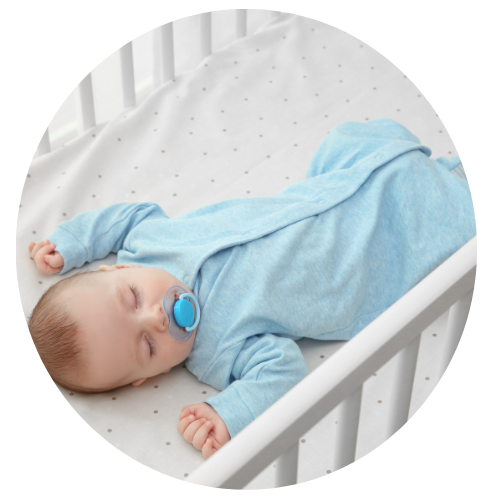
Healthy sleep habits and safe sleep are worth implementing and it is important to maintain them as your baby grows. We may have to adjust schedules, routines, and sleep associations but if you are staying on top of these needed changes, your baby’s safe, great sleep will stay intact.
Breaking it down
Feeds
Once babies are 6 months of age, they are ready for more awake time, with nursing/bottles every 4 hours. Depending on your child’s developmental needs you may have already added solid foods at 4 months or you may just be getting started now. Either way this is an exciting (and stressful) transition that can impact your routines majorly! Remember, According to the American Academy of Pediatrics (AAP)¹, infants should receive breastmilk or formula as their primary source of nutrition through the first year of life.
With breastfeeding and bottles, babies should be super-efficient at this point. Nursing sessions are typically much quicker than they used to be, and bottles need to be sped up if they take too long. You still want feedings to be 30 minutes maximum and baby will likely nurse or bottle feed within 15-20 minutes now, less okay too. Babies are easily distracted, and we still want to maximize feedings to get in required calories. During the day, try to find a quiet place to feed your baby to limit distractions. If you are nursing, try a nursing cover to keep baby focused.
Sleep schedule
As baby enjoys consistent nighttime sleep, you can expect naps to get easier and more predictable too. Optimally, baby wakes about 20 minutes prior to their first scheduled feeding of the day, happy and spontaneously. They may play in their crib and get in some much-needed practice for all the new skills they are mastering. If they are happy doing this, you can get a few needed things done around the house before baby is up for the day. However, if they are distressed or crying out for you, go ahead and check on them.
Babies are able to get 11+ hours of nighttime sleep and should take 2 naps until baby’s first birthday⁵. At 6-7 months, a 2-hour awake window before their first nap is appropriate, a 3-hour window between morning and afternoon nap is a good goal, and a 3-4 hour awake window before bedtime is helpful. Babies may continue to take a “cat nap” between the afternoon nap and bedtime until the 6-8 month mark. This short evening catnap (30-45 minutes) helps bridge the gap to bedtime until babies are ready to drop it. This nap fades away, so continue to offer until baby hasn’t fallen asleep for this nap for a week consistently.

The American Academy of Pediatrics (AAP) recommends starting solids after the 6-month mark². Talk with your pediatrician to decide when is right for your baby to venture into the world of solids. In general - you can tell babies are ready for solid food transitions when they:
Show good head & neck control
Express interest in what you are eating or drinking. They may grab at your cup or watch you closely when you are eating.
Mimic you - making the same facial expressions as when you eat or swallow
These are all great signs that your baby is getting ready to eat solids³, but before you make the leap…remember, chat with your pediatrician first. Contrary to popular belief, eating solids does NOT help promote better sleep so this is not a good reason to start solid foods.⁴
Being consistent and persistent is key…
Awake windows are important to note in order to build an appropriate schedule, but don’t adjust day to day based on how baby is acting or sleeping. Baby cannot be consistent if we do not keep a structured daytime schedule.
There may be days you have a harder time with naps, are traveling, or just on the go for the day. Feed baby on their schedule and let them nap on the go. Naps may not be perfect, but if you feed baby on time and get them in bed on time for bedtime, nighttime sleep should generally stay intact.
By offering feeds on time you are maintaining enough of their schedule to keep nighttime sleep going strong. If you get off schedule, feed again at the next scheduled time to jump right back on track.
Supporting strong sleep habits
At 6+ months, your baby has the ability to sleep 11+ hours at night, without nighttime feeds (even with 2-3 naps per day)! If you are still feeding baby in the middle of the night, with your providers permission, continue to increase baby’s daytime ounces/calories so your baby no longer needs the nighttime snack. A full tummy at night doesn’t keep your baby asleep, enough calories during the day does. This is a great topic for your coach!
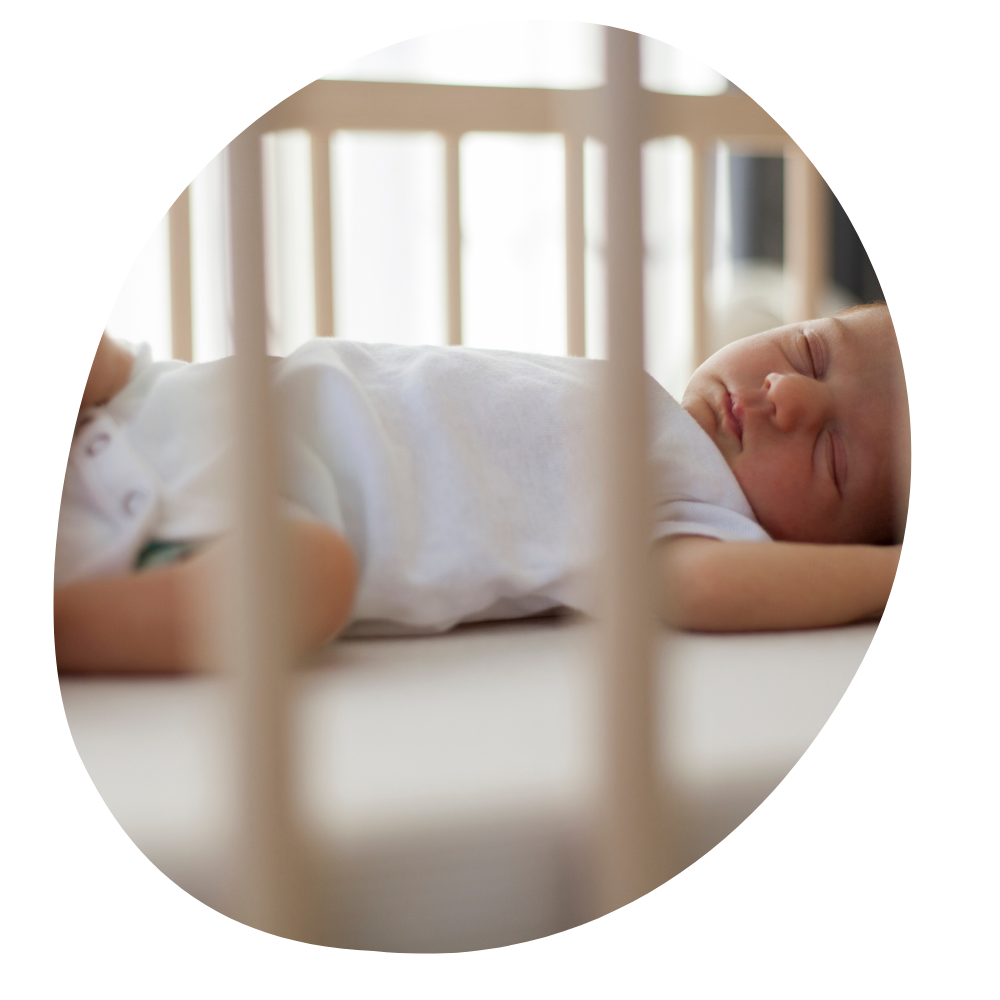
Optimally, anytime your baby goes into their safe sleep environment, they fall asleep easily and independently. In order to facilitate this, families can focus on four important elements to foster safe and consistent sleep: (1) sleep environment (2) sleep associations (3) sleep routines and (4) sleep schedules.
-
Until this point, the AAP recommends room sharing⁷, but now that your baby is over 6 months, a crib in baby’s own room, with the ability to control the light is very effective. Babies are very aware of their surroundings and room sharing can make sleep (for everyone) more difficult at this point.
The crib should be free of any extras - just baby, fitted crib sheet covering the mattress and the mattress itself.
Clear the crib of any toys, mobiles, bumpers, blankets or extra bedding.
Black out shades are great as you want the nursery to be pitch black at night and pleasantly dark for naps.
-
White noise and sleep sacks are great options for sleep associations at this age.
White noise should be constant white noise, not lullabies or waves.
Sleep sack should be made of lightweight fabric, giving baby the ability to position themselves with arms free.
-
Implement a predictable bedtime routine.
Start with a bath each night.
After a playful bath, dress and feed baby in their room with the lights low.
Consider adding a soft book and song, keeping every night the same.
-
A consistent daytime schedule ensures you are getting in the feedings, naps, and developmental playtime needed for great night’s sleep.
Setting realistic expectations
Anytime baby goes down for a nap or bedtime, we have to expect it will take them a reasonable amount of time to fall asleep, just like it takes us time to fall asleep once we hit the pillow. Finding their own comfy spot and drifting off into their first sleep cycle can take up to 20 minutes⁸. If all their needs are met, such as a clean diaper, fed on time, and placed in bed on time, you should allow baby this time to fall asleep independently.
There will be times baby doesn’t fall asleep within 20 minutes and/or doesn’t sleep well for nap or nighttime. Not every nap will be perfect, don't beat yourself up or throw in the towel! Baby is learning alongside you! Here are some soothing tips to implement, while still fostering those great sleep habits.
Wait a reasonable amount of time before returning to the bedside. If we are too quick to step back in, we may be making it harder for baby to get into a good sleep pattern by themselves. Trust your instincts and check on baby if you feel they are in distress.
Soothe from the side of the crib rather than picking baby up. Try loud shhhhhh shhhhhh and patting their bottom or rubbing their tummy.
If baby is using a pacifier, help them find it. If you repeatedly are needing to help baby find the pacifier, it may not be as helpful as it once was and taking away the pacifier may be more effective. Stay for a minute or two and then step away to give baby another chance to drift off to sleep. Continue these intermittent soothing intervals until baby falls asleep independently.
Stay consistent and remember falling asleep independently is a skill and not something baby learns overnight. Your job as a parent is to coach them incrementally in the right direction!
Staying asleep
While the goal is consistency, for you and baby, there will be hiccups along the way!
If baby wakes early from a nap, first wait to see what baby is going to do. As baby shifts through sleep cycles, there are brief transitions. This means baby will wake between sleep cycles and will need to find their way back to sleep. We need to give baby time to try before intervening. Just as it may take baby up to 20 minutes to fall asleep, it can take some time for baby to fall into subsequent sleep cycles. If baby is still not back to sleep after giving them an opportunity to try, offer soothing from the side of the crib as you would initially putting them down, unless it is close to the next feeding time and not worth baby trying to get back to sleep again Trust your instincts and check on baby if you feel they are in distress as you wait to see if they fall back to sleep.
If you hear baby at night, first pause and see what happens. Just as baby shifts through sleep transitions for naps, baby has many transitions during the night. If baby does not find their way back to sleep in 20 minutes, check on them, and offer soothing from the side of the crib. If baby has any signs of illness, do what you can to make them comfortable. If baby has a dirty diaper, change them, and place them back in the crib. If all of baby’s practical needs are met, continue to soothe baby intermittently, extending the intervals you return to the nursery, until baby falls back asleep. If you have a few off nights, this is a good time to assess your schedule and sleep plan to see if changes are necessary . . .
Pacifiers and pacifier weaning
Pacifiers have been shown to decrease SIDS risk and may be offered up until 12 months of age⁹. If baby is able to find the pacifier on their own in the crib and you don’t have to help them find it and put it in their mouth for them, then the pacifier can be a helpful sleep association as well. Place a few pacifiers in the crib for baby to find on their own for naps and bedtime, and keep them there. During the day we want baby talking and exploring with their mouth. Additionally, there is less of a chance the pacifier will cause dental and speech concerns if only offered for sleep, rather than 24/7¹⁰.

Pacifier weaning
All good things must come to an end, and at some point, this means the pacifier needs to go. The American Academy of Pediatric Dentistry (AAPD) recommends weaning the pacifier after 12 months¹¹. Here are some tips to help with this transition:
If you have been using the pacifier for more than just sleep, start this transition by keeping the pacifier in the crib.
Once the pacifier is just a sleep association, eliminate the pacifier from nighttime and keep for naps. The drive to go to sleep is higher at nighttime.
Once babies are over 12 months old, you can replace the pacifier with a lovey.
If you have sized up the pacifier, offer the smaller size as this is different and less attractive.
Stay consistent, after a few days of eliminating the pacifier, baby will learn other ways to soothe. At this age, baby relies on their parents to help them cope with challenging emotions. Your warm, attentive presence can do wonders for them during this transition. You know your baby best - sing to them, rock them, walk around outside for distraction options during the day.
If this seems too much at this point, consider waiting until baby is older. A toddler 2-3 years of age is able to say goodbye to the pacifier, by planting a pacifier garden or giving to the pacifier fairy. We will go into more detail here in our toddler module.

What the research says
While you know your baby best, it is important to follow the research and guide your baby through upcoming transitions based on recommendations from our trusted medical and dental professionals.
Babies over 6 months of age are able to enjoy 11+ hrs of nighttime sleep and 2-3 naps (2-4hrs) of nap sleep⁵.
Healthy sleep habits are attainable even when switching gears after 6 months⁷.
Insufficient sleep, poor sleep quality, and irregular sleep schedules may affect children’s physical health, cognitive capacity, socio-emotional processes, and behavioral functioning, with implications for children’s development and well-being¹².
While you may be anxious to start solids for various reasons, the AAP recommends waiting until 6 months to venture into the world of solid foods⁴.
Contrary to popular belief, eating solids does NOT help promote better sleep so this is not a good reason to start solid foods⁴.
Pacifiers can be super helpful for some families the first 6, even 12 months. The risks start to outweigh the benefits as babies get older. Anticipate this needed change and follow our tips to help with this transition¹¹.
Pacifiers have been shown to decrease SIDS risk and may be offered up until 12 months of age⁹.
About the author
Melissa O’Neill, BSN
As an RN specializing in NICU and Labor & Delivery for 15+ years, Melissa is also a mother of 3.

Nutritionists
•
Adult mental health
•
Couples mental health
•
Infant & child mental health
•
Sleep coaching
•
Nutritionists • Adult mental health • Couples mental health • Infant & child mental health • Sleep coaching •

When to get
expert support
It is expected to have concerns about your baby’s health. Here are few guidelines on when to seek help.
Call your pediatrician if your baby:
1) is not eating well
2) lacks an interest in feeds
3) is spitting up excessively
4) has spit up that is projectile or discolored
5) has a persistent diaper rash that isn’t improving
6) has a white tongue that cannot be scratched away with your clean finger
7) has not had a dirty diaper in over three days or is having hard, pebble-like stools, stool is gray, black or blood tinged
8) has a persistent fever over 100.4 F
Consider calling 911 or going to the nearest emergency room if your baby:
1) experiences swelling of the lips and face (this may be due to a change in baby’s diet and/or rash and may be accompanied by stool changes and fussiness)
2) has difficulty breathing - like breathing fast, wheezing, retractions in chest between and under ribs (check in with your pediatrician or ER if after hours)
3) turns blue around the mouth or lips
*Always trust your parental instinct. If you feel like something is wrong, reach out to your trusted medical professional asap.
Reach out to a mental health professional for support if you find yourself feeling down, anxious, or not like yourself. You can also call or text the National Maternal Mental Health Hotline at 833-852-6262 (available 24/7 in the US).
You may benefit from meeting with a mental health professional if maintaining a consistent schedule or knowing when to respond to your baby overwhelms you or increases anxiety.
If you are in a moment of crisis, call 988 for mental health support (available 24/7).
-
“Infant Food and Feeding.” Home, www.aap.org/en/patient-care/healthy-active-living-for-families/infant-food-and-feeding/?srsltid=AfmBOoqFkqiRKFr0muKHKwbtN4G30lnBXS_qc7I0_JkAr3azM2-xzlIS. Accessed 30 Aug. 2024.
Policy Statement: Breastfeeding and the Use of Human Milk, publications.aap.org/pediatrics/article/150/1/e2022057988/188347/Policy-Statement-Breastfeeding-and-the-Use-of.
More, J., Jenkins, C., King, C., & Shaw, V. (2010). Weaning infants onto solid foods. British Dietetic Association (BDA) Specialist Paediatric Group.
Brown, Amy, and Victoria Harries. “Infant sleep and night feeding patterns during later infancy: Association with breastfeeding frequency, daytime complementary food intake, and infant weight.” Breastfeeding Medicine, vol. 10, no. 5, June 2015, pp. 246–252, https://doi.org/10.1089/bfm.2014.0153.
Paruthi, Shalini, et al. “Consensus statement of the American Academy of Sleep Medicine on the recommended amount of sleep for Healthy Children: Methodology and discussion.” Journal of Clinical Sleep Medicine, vol. 12, no. 11, 15 Nov. 2016, pp. 1549–1561, https://doi.org/10.5664/jcsm.6288.
Paruthi, Shalini, et al. “Consensus statement of the American Academy of Sleep Medicine on the recommended amount of sleep for Healthy Children: Methodology and discussion.” Journal of Clinical Sleep Medicine, vol. 12, no. 11, 15 Nov. 2016, pp. 1549–1561, https://doi.org/10.5664/jcsm.6288.
Moon, Rachel Y., et al. “Sleep-related infant deaths: Updated 2022 recommendations for reducing infant deaths in the sleep environment.” Pediatrics, vol. 150, no. 1, 21 June 2022, https://doi.org/10.1542/peds.2022-057990.
Bruni, Oliviero, et al. “Longitudinal Study of sleep behavior in normal infants during the first year of life.” Journal of Clinical Sleep Medicine, vol. 10, no. 10, 15 Oct. 2014, pp. 1119–1127, https://doi.org/10.5664/jcsm.4114.
Hauck, Fern R., et al. “Do pacifiers reduce the risk of sudden infant death syndrome? A meta-analysis.” Pediatrics, vol. 116, no. 5, 1 Nov. 2005, https://doi.org/10.1542/peds.2004-2631.
Policy on Pacifiers, www.aapd.org/globalassets/media/policies_guidelines/p_pacifiers.pdf.
“Pediatric dentistry.” Clinical Dentistry Daily Reference Guide, 29 Apr. 2022, pp. 575–603, https://doi.org/10.1002/9781119690733.ch17.
Schlieber, M., & Han, J. (2021). The Role of Sleep in Young Children’s Development: A Review. The Journal of Genetic Psychology, 182(4), 205–217. https://doi.org/10.1080/00221325.2021.1908218