
Play
Play for newborn - 12 months
20 MINUTE READ
Published August 2024
AUTHORS
Katie Sardone, PhD PMH-C
Head of Clinical, Licensed Psychologist & Perinatal Mental Health Specialist

Margaret Vadiee, PhD
Contributing Editor, Licensed Psychologist

For children, play isn't just for fun – it's a crucial part of development. Learn how to foster age-appropriate play in your daily routine.

A newborn plays!?

Yes!! Okay well… maybe not in the traditional sense of stacking blocks or dressing up in a doctor’s coat. But children of ALL ages play - even infants - and play looks different at each developmental stage. From the earliest days you can think of play as simply responding to your child. Their favorite game is you! They want to see your face, relish in your eye contact, soak up your attention, and enjoy your smiles and laughter. You cannot spoil a baby! Spending time delighting in your infant and engaging in a riveting back and forth babble conversation will fill your infant’s “play” cup.
Breaking play down further
Over time, play shifts and changes, and there are also different forms of play that serve different developmental purposes. Here are the 3 types of play you should think about as a parent:
-
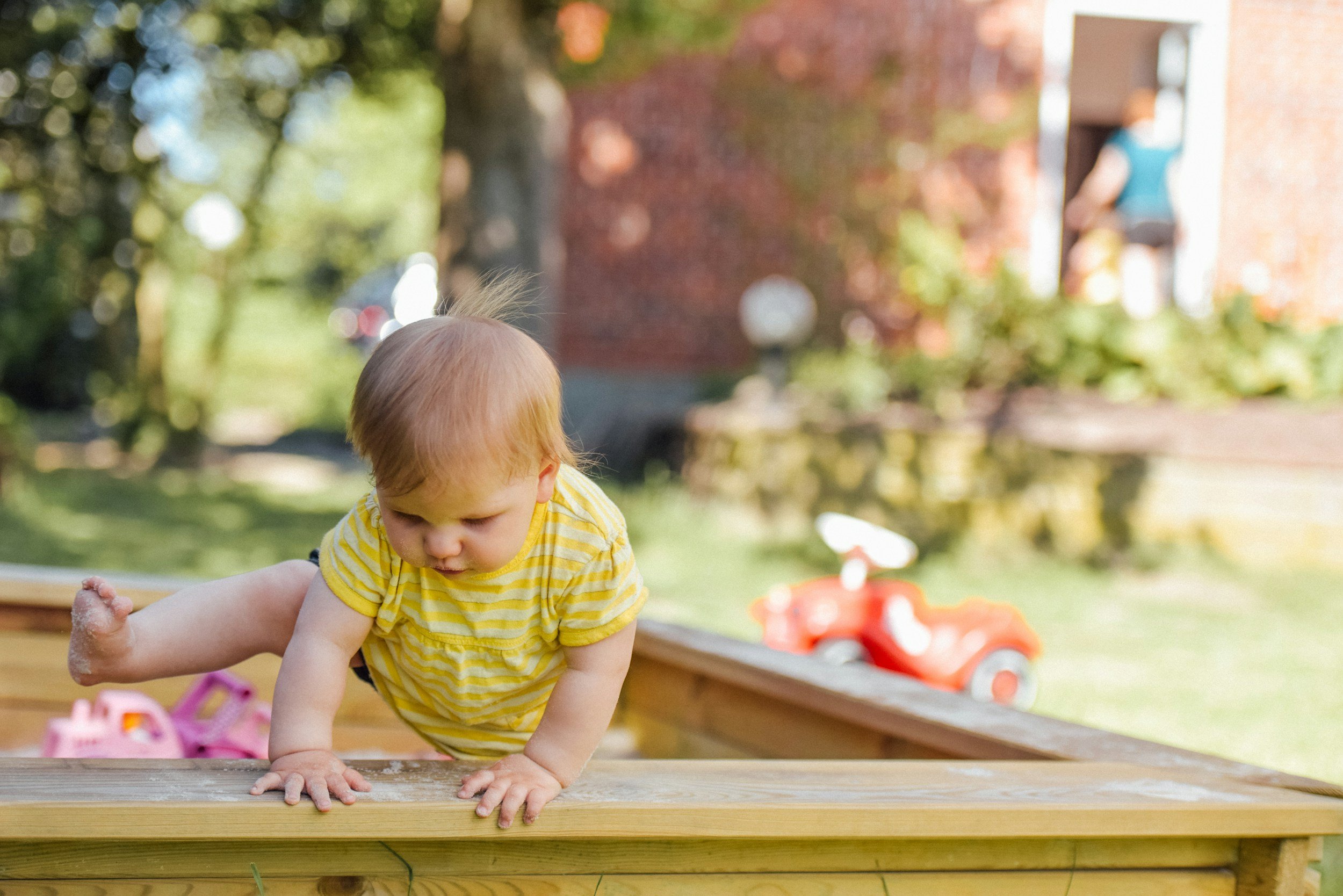
Just like it sounds, it involves physical movement and exercise (e.g., playing on a playground, running in the yard, jumping on a trampoline, skipping). This physical play promotes coordination, motor development, and also provides the same benefits of adult exercise (e.g., improved mood and sense of well-being).
-
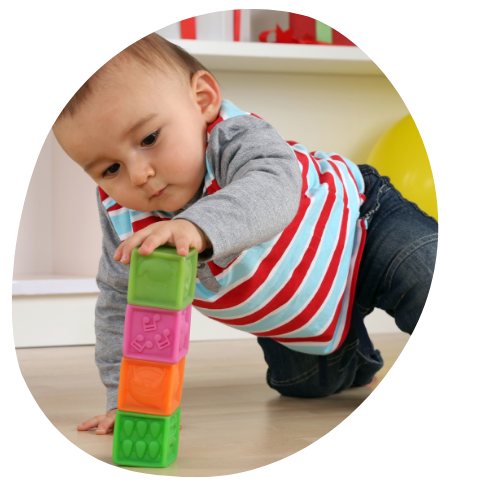
This is all about creating! Babies and toddlers love to build and construct block towers, and create art and toys with cardboard boxes. Anytime a child is building something, they are developing visuospatial skills, developing fine motor skills and better understanding language and concepts associated with their creations (e.g., “big," "small," "on," "under").
-
Pretend play is the final play form which develops between 18 – 24 months of age. In pretend play, children try on different roles, use their imagination, and engage in fantasy play. You might see a child pretending to cook a soup in her play kitchen or walk an imaginary dog on a leash. These children have discovered the freedom and magic of creating and trying out any scenario in the world right in their very own home.

What the research says
We usually think of “playing” as something that’s done just for ‘fun.’ Play is fun, but for children it doesn’t just serve a recreational purpose. Play is the “work” of a child. Children use play as a way to:
🌎 Learn; Understand themselves, others and the world around them.
😎 Try out new roles
😨 Process difficult experiences, or manage big feelings.
✍ Practice or develop new skills
🤝 Build relationships with family and friends.
Play is also a fun way to build on developmental progress and promote overall developmental health and well-being.
REMEMBER: You do not need to engage in specific play behaviors (or have specific toys!) to bring about developmental milestone achievement, but rather these strategies build on natural development over time and should allow for low-stress and enjoyable interaction between you and your child.
What play might look like for your family…
There’s no one “right” way to play. In the table to the right, each age gives you more ideas of ways to play based on their developmental level, but you can continue using all the strategies from prior ages if you and your baby are enjoying it. If you are engaging with your child in a way you both like, keep doing it! Some playtime activities overlap with doing basic things to care for your child (e.g., bathtime).
Important reminder: Toys should be evaluated for age appropriateness and used only as indicated by the manufacturer. Small parts can pose a choking hazard for children. Play should always be supervised by an adult.
-
How to play:
Simply hold your baby (in your arms or wearing them).
Start tummy time! Do it on your chest for skin-to-skin time too.
Put high contrast pictures near your baby for them to look at.
Shake a rattle. Let them watch and listen.
Bath time (or a wet washcloth wipe down).
Rub or give little kisses to your baby’s toes & tummy.
Go on a stroll outside. Tell your baby about their new neighborhood as you walk through it.
Listen to music & dance. Sing songs.
Smile & make faces.
Use that sweet sing-song voice you can’t help but do around babies.
Play accessories around the house:
General tools: mobile or pictures with black and white colors and patterns, music players, sturdy rattles, stroller, baby wearing sling or carrier
Physical play: soft blanket or mat for floor time
Constructive play: NA at this age
Pretend play: NA at this age
-
What your baby is doing: In these early days, babies play through beginning to smile, enjoying face-to-face contact with caregivers (babies love exaggerated facial expressions), listening to music, and listening to their parents.
What you can be doing:
Talk to your baby! Narrate what you are doing.
Give your baby different views by moving them around the house.
Hold a rattle or an object about 10-12 inches from your baby’s face. Move it around slowly to let them practice visual tracking.
Look at each other. Make eye contact. Make exaggerated facial expressions.
Let your baby lie on an activity mat with objects hanging over their head.
Tell nursery rhymes.
Gently rub their hands & feet. Gently rub different fabric textures on your baby’s skin.
Sing lullabies.
Lightly blow on their tummy.
Put your baby in a bouncer.
Imitate your baby’s noises.
Read books.
Start moving a rattle at different speeds and in different patterns.
Greet your baby when you walk in the room.
Lay them on a soft mat on the floor and let them kick
On the activity mat with the mobile, have things within reach of their hands and feet so they can touch them by moving their arms and legs.
Have “conversations.” Listen to their noises. When they pause, respond back; then, pause so they can answer.
Spend time outside!
Gently lift your baby up and down so they can look at you from different angles.
Lightly tap your baby or tap a closeby counter to different rhythms.
See if your baby can hold a rattle. Listen to it make noises as they move it.
Move bright colored toys around them and let them practice visually tracking them.
Make animal sounds.
Tools to support different types of play:
General tools: mobile with high contrast colors and patterns, music players, soft brightly colored toys that make gentle sounds, sturdy rattles
Physical play: soft blanket or mat for floor time
Constructive & physical play: NA at this age
Pretend play: NA at this age
-
What your baby is doing: As baby continues to grow, she interacts with others through "conversations," giggling, and movement. She enjoys smiling back and forth with caregivers, and can laugh and mimic sounds to show interest and attention. Baby will like being outside and watching the leaves move on a windy day. Baby also enjoys mirror reflections.
What you can be doing: Since baby is developing more interest in others, this is a great time to start introducing baby to other children and parents (watch cues for readiness to meet people and be quick to give her breaks when she's not feeling social). From this point forward, daily play time on the floor is very important and helps enhance development. Consider developing a daily floor play routine to enjoy with your sweet baby! Take turns cooing, dance with your baby while listening to rhythmic music, or tell her all about the neighborhood while you're out on a walk. Make silly faces in the mirror together. Some ideas to keep you busy:
Your baby may be ready to practice sitting up.
On your activity mat, have items hung so your baby can practice reaching for them.
Let your baby practice holding objects of different shapes and sizes.
Blow bubbles and let your baby watch them float and pop.
Play peek-a-boo.
Play “This Little Piggy Went to Market.” It’s fun, and can help with building awareness of their body.
Carry/wear your baby while doing household tasks.
Talk to your baby about what you are doing with them (e.g., diaper changes, bath time).
Look in the mirror.
Hand your baby toys to one of their hands and then the other. Eventually, they’ll learnhow to transfer items from one hand to another.
Let your baby watch you bounce a ball.
Sit down on the floor with your baby while they explore their surroundings.
Let your baby be around other babies; they won’t really interact, but will enjoy looking at each other.
Sing Pat-a-Cake and show them the motions. Use instruments!
Roll a ball to them. They may swat at it and send it back to you.
Start waving and saying “bye bye” when you walk out of the room.
Tools to support different types of play:General tools: unbreakable mirror with soft edges, soft balls, textured toys that make sounds, toys that have finger holds, musical toys (bells, maracas, tambourines), board books with bright colors and different textures.
Physical play: soft blanket or play mat for floor time
Constructive play: baby blocks and soft toys to stimulate hand-eye coordination
Pretend play: NA at this age
-
What your baby is doing: Play with baby can become increasingly reciprocal as they develop physically, cognitively and socially. Children like to pick up small items practicing their new fine motor skills (e.g., placing objects in a container and dumping them out), scribbling with crayons and initiating "patty cake."
What you can be doing: Play "hide and seek" games such as "peek a boo" or "hiding" your face and then finding "mommy" or "baby." Sing-along songs that involve hand and body movements can also be a fun and engaging activity at this age. Don't forget that daily floor play time and consider making bath time fun with floating toys that squirt or hold water.
Tools at home to support play:
General tools: Mirrors, squeezable toys (e.g., toys that make sounds or bath toys that squirt), safe toys without hard edges such as dolls, cars, and balls. Toys that play music. “Activity center” toys with many bright colors, textures, and items to flip, turn, scoot, etc. Board books with large pictures. Make sure the parts are not small enough to fit into baby's mouth.
Physical play: activity centers, play mat or soft area to practice crawling or walking, outdoor swings
Constructive toy: large building blocks, stackable toys (e.g., stackable cups or pails)
Pretend play: Toys that mimic real household items (e.g., kitchen toys, telephone, hair dryer, etc.) Note that we don’t expect pretend play to develop until 18-24 months.
About the authors
Katie Sardone, PhD, PMH-C
Dr. Katie Sardone is a Licensed Psychologist and the founder of Behavioral Health Dallas, PLLC.

Margaret Vadiee, PhD
Dr. Margaret Vadiee is a Licensed Psychologist and a former Adjunct Clinical Assistant Professor at Southern Methodist University in the Psychology Department.

Nutritionists
•
Adult mental health
•
Couples mental health
•
Infant & child mental health
•
Sleep coaching
•
Nutritionists • Adult mental health • Couples mental health • Infant & child mental health • Sleep coaching •

When to get
expert support
Sometimes you might need more support, and that's okay! Here are times you may consider reaching out to a specialist:
You feel way too exhausted to even think about engaging with your child.
You find yourself staring blankly at your child whenever you are around them.
You are worried about how play may go wrong… and it distracts you from enjoying the moment.
-
Altmann, T., Hill, D. L., Shelov, S. P., & Hannemann, R. E. (Eds.). (2019). Caring for your baby and young child: Birth to age 5 (7th ed.). Random House Publishing Group.
Segal, M. (1998). Your child at play: Birth to one year. Discovering the senses and learning about the world. Newmarket Press.
Siegel, D., & Bryson, T. P. (2021). The power of showing up: How parental presence shapes who our kids become and how their brains get wired. Random House Books.
Zachry, A. H. (2014). Retro baby: Cut back on all the gear and boost your baby’s development with more than 100 time-tested activities. American Academy of Pediatrics.
Zachry, A. H. (2018). Retro toddler: More than 100 old-school activities to boost development. American Academy of Pediatrics.