
Mental & Emotional Health

Riding the Wave of Emotion
The highs and the lows
20 MINUTE READ
Published August 2024
AUTHOR
Margaret Vadiee, PhD
Contributing Editor, Licensed Psychologist

“Look mommy!” your toddler screams as they pick up a red leaf that had recently fallen from the tree. They are overjoyed at finding the leaf that they have deemed to be extra special and beautiful. You delight in their joy and let them cherish the moment. Then… your toddler says, “Nooooo” with a big frown as they realize they stepped on their cherished leaf and it broke into tiny pieces. They are overwhelmed with sadness at the loss of their special, beautiful, irreplaceable leaf. Emotions in toddlerhood can arise suddenly like a big wave in the ocean. We’ll show you how to ride the wave of emotion to reach calmer and more predictable waters.


Emotions inform us!
Toddlerhood is a phase filled with strong emotions. We know you know this! Your toddler is right on track when an intense emotion hits. Expect it. It’s normal and healthy. Toddlers carry their emotions on their sleeves and their feelings are largely unfiltered due to the premature development of their frontal lobes. These big, raw and authentic emotions can feel like they come out of nowhere (you may not understand them and your toddler might not either!). We’ll teach you the basics on emotions and how they manifest physiologically in our bodies. You’ll be equipped with information to not only understand your toddler’s emotions, but also teach your toddler about them too!
Breaking it down further

What are emotions anyway?
Everyone feels emotions. Your toddler, your neighbor, your colleague, your friend, and even you! We all experience the full range of emotions - moments of joy, moments of heartache, moments of fear, etc. Emotions are temporary experiences that accompany physiological responses in our bodies and thoughts in our mind. Although they may feel like internal experiences, an expression of emotion also serves as a method of communication with others and ourselves (e.g., helping us understand our thoughts in a situation). Emotions go hand-in-hand with thoughts and behaviors. For example, if you are worried about a review at work, you will notice that you feel anxious, your thoughts may be about a worst case scenario and your behavior (pacing around the room and wringing your hands) might demonstrate to others just how worried you are. We need all three of these data points to help us navigate the world (thoughts, feelings and behaviors). In order to understand emotions, it can be helpful to know what they are not. For example, emotions are not your personality; just because you feel angry, doesn’t mean that is who you are as a person through and through. Emotions are not our identities; who we are is not rooted in the emotions we feel¹. Finally, emotions are not problems to get rid of as quickly as possible; in fact pushing down emotions or avoiding them can cause acute and chronic problems for children and adults².
The physical sensation of an emotion
We feel emotions all throughout our bodies. Experiencing a strong emotion, or a different emotion, is still a new phenomenon for a toddler. They are still figuring out what it means when their heart starts racing and they suddenly feel hot. You can help your toddler grasp what is happening to them by talking with them about the physiological manifestation of emotion in their bodies. Here are some common ways emotions impact our physiological state:
-
Smiling
Wanting to jump up and down
Wiggly
Relaxed shoulders and jaw
Smiling eyes
Happy screams
-
Racing heart
Shortness of breath
Sweating
Feeling hot
Knot in your stomach
Lump in your throat
Tears welling up behind your eyes
Crying
Teeth chattering
Headaches
Muscle tension
Legs shaking
Hands fidgeting
Feeling like you have to go to the bathroom
Shrieks
-
Racing heart
Shortness of breath
Sweating
Feeling hot
Headache
Muscle tension
Furrowed brow
-
Knot in your stomach
Lump in your throat
Tears well up behind your eyes
Crying
Headache
Hands shaking
Lips quivering
Frown
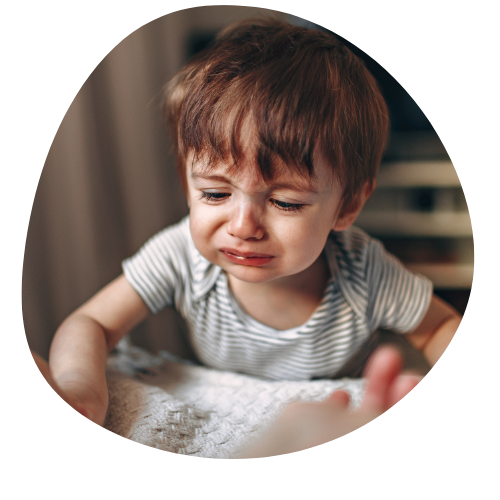
Babies and toddlers have emotions!
Despite infants not being able to communicate through language about the nuance of how they are feeling, emotion actually develops very early on and continues to grow in complexity throughout early childhood. Within the first two months of life, infants can feel interest, joy, and distress. By 4 months old, there are physiological differences in how infants feel fear, anger, and sadness. The frequency at which a baby feels angry increases from 4 months old to 19 months³. But a baby does not feel jealous; that emotion doesn’t develop until much later on⁴. Check out the Developmental Milestones guide for more information.
So what do we do with these emotions?
Our emotions have an important function. The goal is not to only feel positive emotions or never feel negative ones. . If we strive for that, we are striving for an impossible goal. (And if someone were to achieve it. I’d be quite concerned!). The goal is to accept and normalize that we all feel the full range of emotions, and focus on responding to our emotions in a helpful way. You want your toddler to know that nothing is wrong with them for feeling all sorts of things. It really is okay.
Beyond just acceptance of the emotion, we can use the emotion as a clue to help us better understand a situation. When a toddler experiences an emotion, we want that to spark a sense of wonder and curiosity in the parent. Why might my toddler be feeling that way? What is going on in their world? What are they perceiving to be happening? What are they reacting to? The answers to these questions, or really your best guess at the answers to these questions, can help you better understand your toddler’s needs. As the Creating Strong Bonds guide explains, paying attention to our children’s needs and responding to them is essential in developing and maintaining a healthy relationship with our children.
Co-regulation for the win!
In response to a strong emotion, a toddler turns to their parents for support. This is what they were biologically designed to do. They are hard-wired to seek support from their parents. Infants cannot regulate their own emotions, and completely rely on their parents to soothe them. Toddlers weren’t designed to cope with their feelings independently, but will gain more independence with coping skills through early childhood as they practice what their parents model for them. They begin to learn how to self-regulate through the process of co-regulating with their parents⁵. Co-regulation is “a warm and supportive interaction that provides the support, coaching, and modeling children need to “understand, express, and modulate their thoughts, feelings, and behavior”⁶,⁷. Each time you help them make sense of their emotional experience, you are taking another step toward your child being able to self-regulate more independently. But you remain an essential part of your toddler’s ability to cope all throughout toddlerhood and early childhood.
Toddlers may or may not really understand why they are feeling a certain emotion, and we may or may not fully understand why they are feeling a certain emotion. Their emotion is just as valid, even if we don’t understand it. It can feel easy to discount their emotional experience when we don’t see the reason behind it, but try not to fall into that trap! Your child is experiencing a real feeling and trying to ask for help with the limited tools they have.
Remember, focus on providing support for their emotional experience regardless of the reason for it⁸. Remember that validating their emotional experience is NOT the same thing as saying their action or behavior is okay. You can say “you are so frustrated that your friend had to leave, that makes sense, but it’s not ok to throw your water cup.” The Intuitive Parenting and Intuitive Discipline guides dive into more detail on validating your toddler’s feeling without reinforcing an unhelpful behavior.
Parents are also going through their own emotional experience. We want to recognize and cope with our own emotions, so we can then help our toddlers recognize and cope with their emotions. Check out the Coping in Chaos guide for more information on managing your own emotional experience in the midst of parenting.
Labeling your toddler’s feelings
Using words to describe what your toddler may be feeling helps them make sense of what is happening to them. It not only helps organize their experience for them, but it also helps move them from the emotion-center of their brain to the part of their brain that helps them process what is happening more logically (Note that we don’t expect toddlers to be logical like adults though! That part of their brain is not fully developed, and will not be for a while).

What the research says
Parenting a toddler well through an intense emotional reaction can actually improve your toddler’s own emotion regulation skills over time⁹.
Mothers who were emotionally regulated had toddlers who were able to be more emotionally regulated when engaging in a challenging task¹⁰.
Toddlers who were more emotionally regulated had less challenges in their social relationships¹¹.
Children learn about how to express and cope with emotions from interactions with their parents. Parents who co-regulate with their young children help them develop more emotion regulation skills over time¹².
Putting it into practice
-
Observe and listen to what physiological manifestations of emotions may be happening for your toddler. Do you see tears welling up behind their eyes? Do you see them grinning from ear to ear? Do you hear them say that their tummy hurts?
-
Try to understand from their perspective what may be going on.
-
It’s okay if you don’t know for sure. Take a guess! Guessing doesn’t hurt, and it’s okay if your toddler corrects you. Validate that it is okay to feel however they feel.
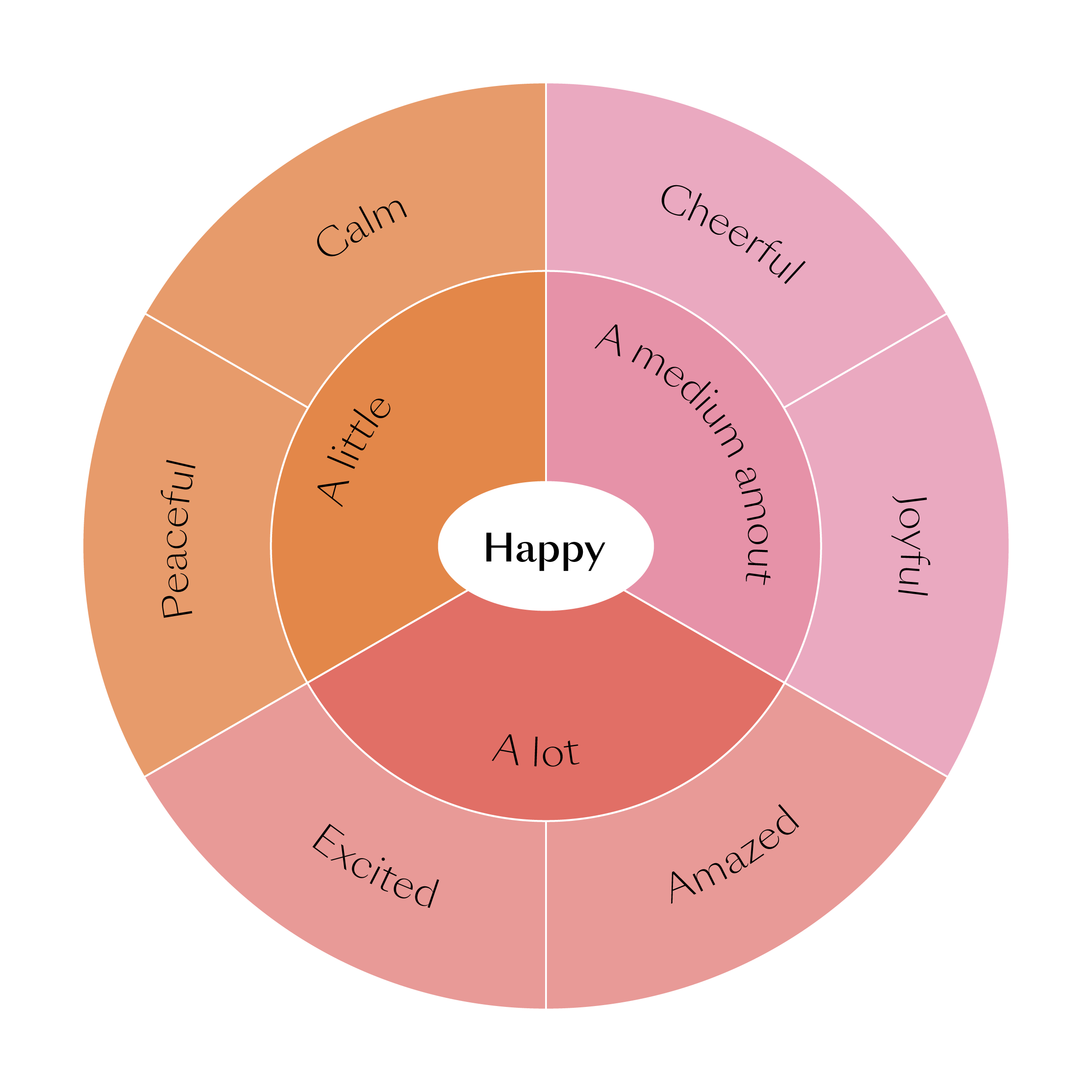
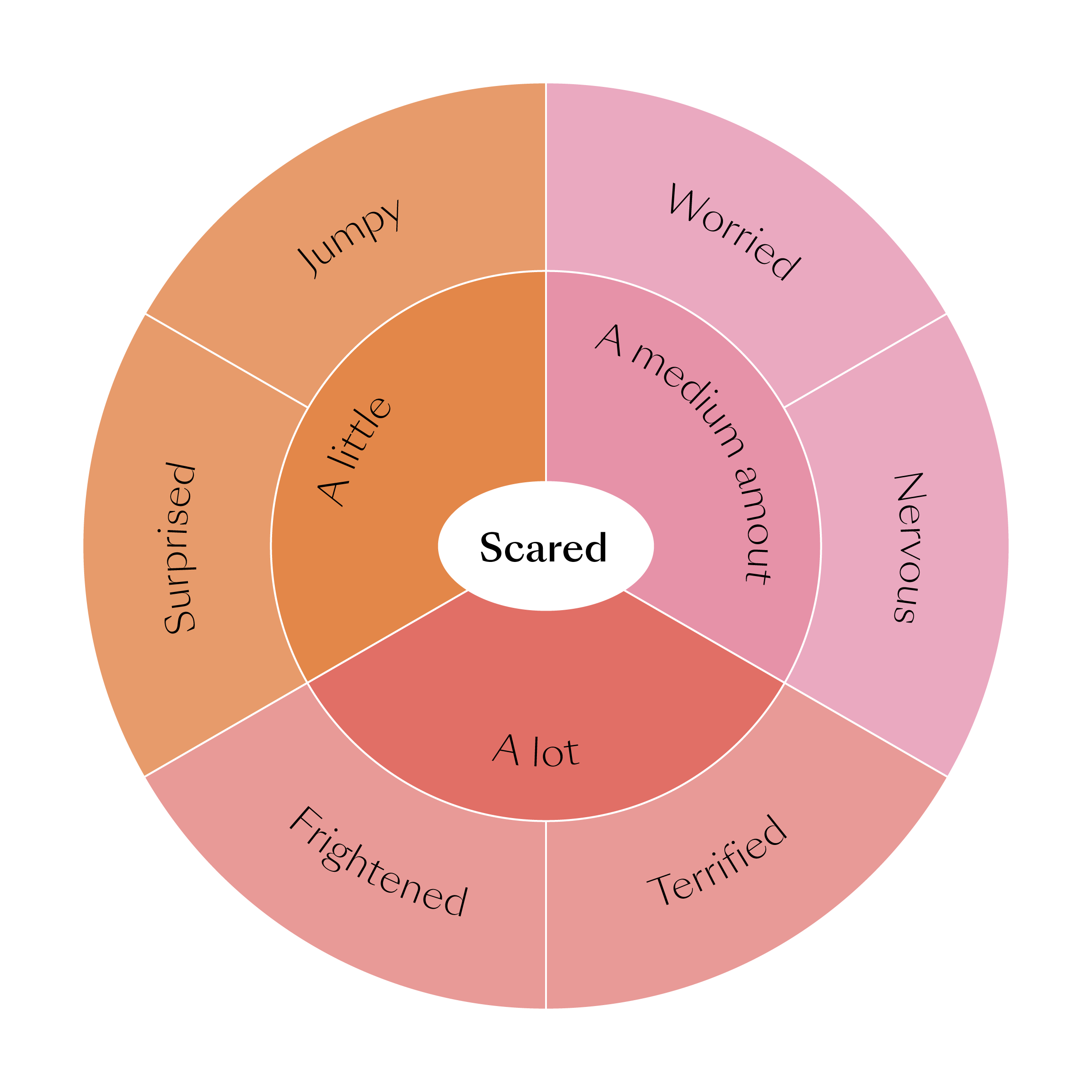
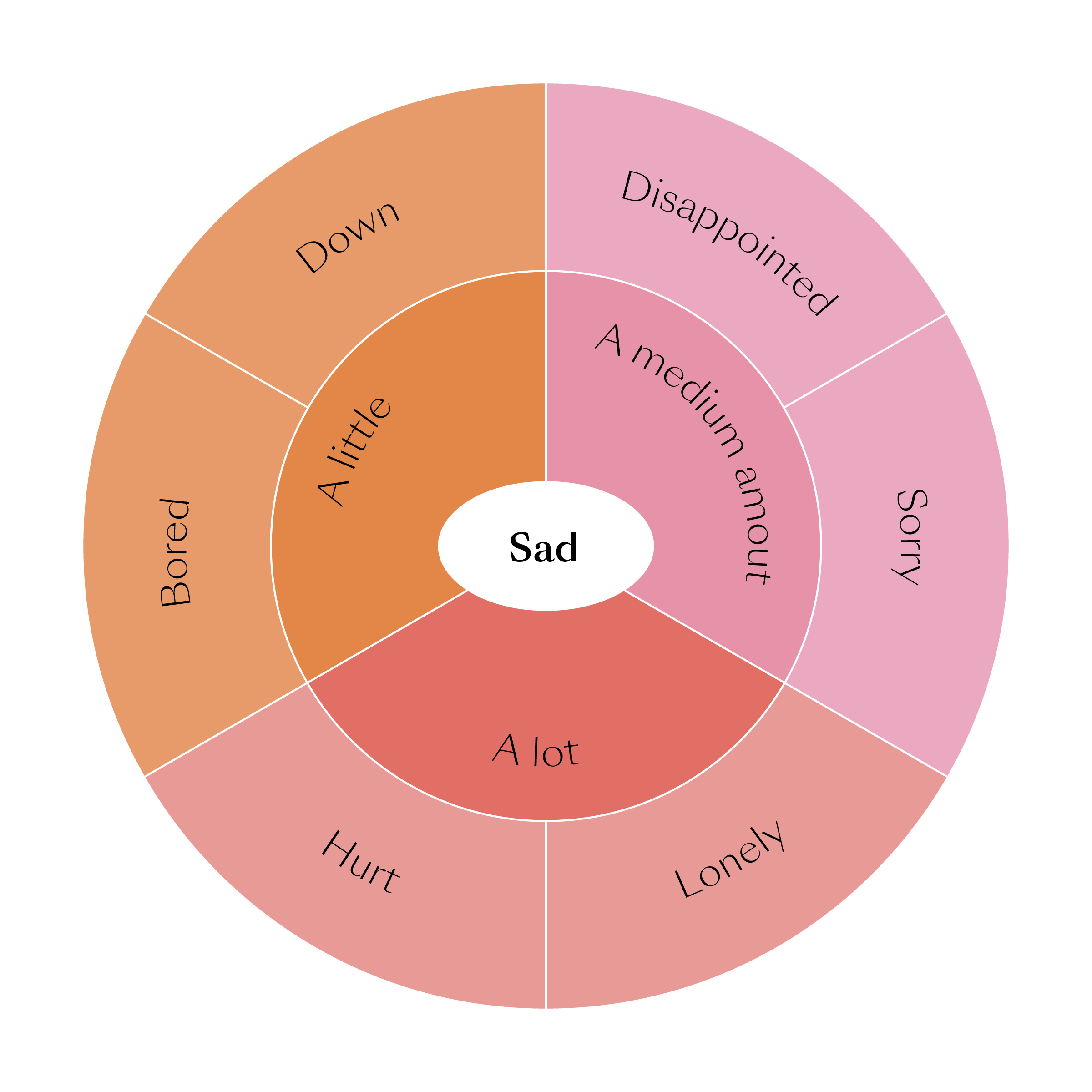
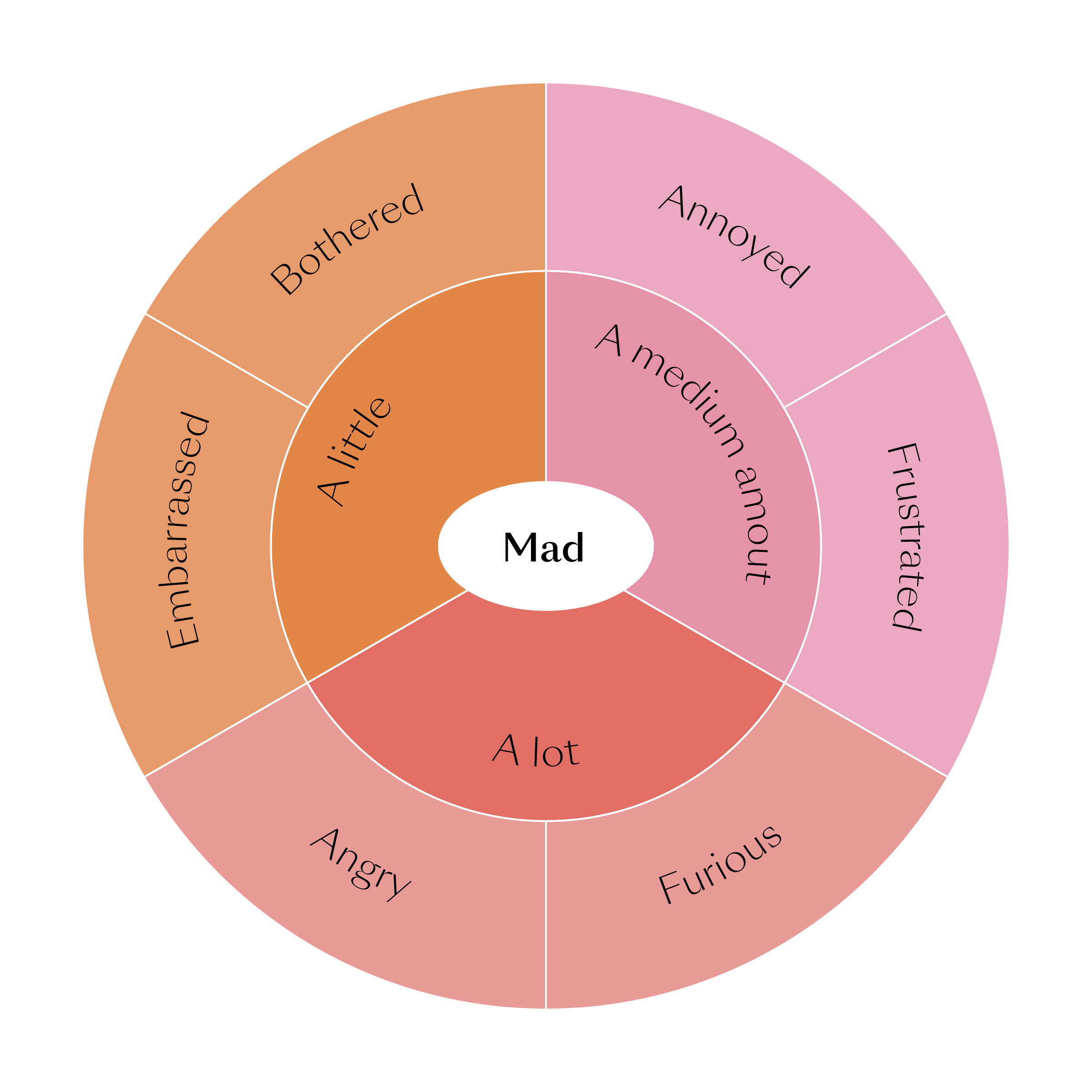
When you start labeling your toddler’s feelings, use basic emotion words like happy, sad, mad, and scared. Toddlers experience these 4 emotions as distinct feelings and can learn that they have a different physiological response to each of those feelings. As your toddler gets older, you can introduce intensities of emotion using 3 categories: a little, a medium amount, or a lot. You can then layer in other feeling words (e.g., frustrated, excited). As you introduce new feeling words, do so slowly when an opportunity presents itself. An experiential moment of learning for your toddler will be more beneficial than trying to teach in a more conceptual manner. See the Feelings Wheels in the Appendix below to guide you through this process.
Some toddlers resist having their emotions labeled aloud. If that’s the case in your household, focus on connecting and being emotionally available for your toddler in other ways. You can show them that they are seen and understood without labeling their emotion if that’s not a good fit for your child. If you are struggling with this (it can feel tricky!), reach out to a mental health professional for more ideas.
-
If a limit needs to be set or the expression of emotion seems more like a tantrum, look to the Intuitive Discipline and Mastering Toddler Tantrums guides for more help.


What it might look like for you
It’s your toddler’s first music class!
-
You notice your toddler is fidgeting with their hands, and their muscles appear stiff and tense.
-
You wonder what your toddler may be feeling, and consider that they may be nervous about the new activity. You remember that this is totally new for them!
-
You say, “You’re feeling a little scared about your first music class. You’ve never done it before and don’t know what is going to happen. That makes sense!”
Your toddler’s popsicle falls in the dirt.
-
You see your child’s lip start to quiver and the tears start to stream down their face almost immediately.
-
It’s easy for you to understand what your child is feeling and why they are feeling it. This one was simple to observe and understand!
-
You say, “How sad! The popsicle fell in the dirt and can’t be eaten anymore. That makes me feel sad too.” You may then decide to get them a new popsicle or set a limit of not getting another popsicle based on what had happened leading up to this moment.
Your toddler just opened their birthday gift - it’s a play set of food that they can cut with a pretend knife!
-
Your child lets out a high-pitched scream full of joy. They are smiling so big it makes their eyes squint and their nose scrunch.
-
You think about your child’s perspective. You know how much they love watching you cook in the kitchen, and are likely thrilled to have their own play set of food.
-
You say, “Wow! You are so happy! You’ve been wanting a toy like this!”
Appendix:
Feelings wheels
About the author
Margaret Vadiee, PhD
Dr. Margaret Vadiee is a Licensed Psychologist and a former Adjunct Clinical Assistant Professor at Southern Methodist University in the Psychology Department.

Nutritionists
•
Adult mental health
•
Couples mental health
•
Infant & child mental health
•
Sleep coaching
•
Nutritionists • Adult mental health • Couples mental health • Infant & child mental health • Sleep coaching •

When to get
expert support
Sometimes you might need more support, and that's okay! Here are times you may consider reaching out to a specialist:
Time and time again, you want to be regulated for your toddler but find it really challenging to manage your own emotions.
You feel like your child’s emotional reactions are more intense than their peers, and may benefit from a consultation with a mental health professional.
You feel lost when you try to teach your children about their emotions.
-
Siegel, D. J., & Bryson, T. P. (2011). The whole-brain child.Constable & Robinson Ltd. London
De Castella, K., Platow, M. J., Tamir, M., & Gross, J. J. (2018). Beliefs about emotion: Implications for avoidance-based emotion regulation and psychological health. Cognition and Emotion, 32(4), 773-795.
Izard, C. E. (2007). Basic emotions, natural kinds, emotion schemas, and a new paradigm. Perspectives on psychological science, 2(3), 260-280.
Izard, C. E. (2011). Forms and functions of emotions: Matters of emotion–cognition interactions. Emotion review, 3(4), 371-378.
Silkenbeumer, J., Schiller, E. M., Holodynski, M., & Kärtner, J. (2016). The role of co-regulation for the development of social-emotional competence. Journal of Self-regulation and Regulation, 2, 17-32.
Gillespie, L. (2015). It takes two: The role of co-regulation in building self-regulation skills. YC Young Children, 70(3), 94-96.
Murray, D. W., Rosanbalm, K. D., Christopoulos, C., & Hamoudi, A. (2015). Self-regulation and toxic stress: Foundations for understanding self-regulation from an applied developmental perspective.
Lieberman, A. F. (2017). The emotional life of the toddler. Simon and Schuster.
Noroña‐Zhou, A. N., & Tung, I. (2021). Developmental patterns of emotion regulation in toddlerhood: Examining predictors of change and long‐term resilience. Infant mental health journal, 42(1), 5-20.
Brenning, K., Robichaud, J. M., Flamant, N., Vansteenkiste, M., Coorevits, N., De Clercq, B., & Soenens, B. (2020). The role of maternal emotion regulation in controlling parenting during toddlerhood: An observational study. Motivation and Emotion, 44, 897-910.
Calkins, S. D., Gill, K. L., Johnson, M. C., & Smith, C. L. (1999). Emotional reactivity and emotional regulation strategies as predictors of social behavior with peers during toddlerhood. Social development, 8(3), 310-334.
Morris, N. (2015). Parent-child co-regulation predicting emotion regulation in early childhood. The University of North Carolina at Greensboro.